

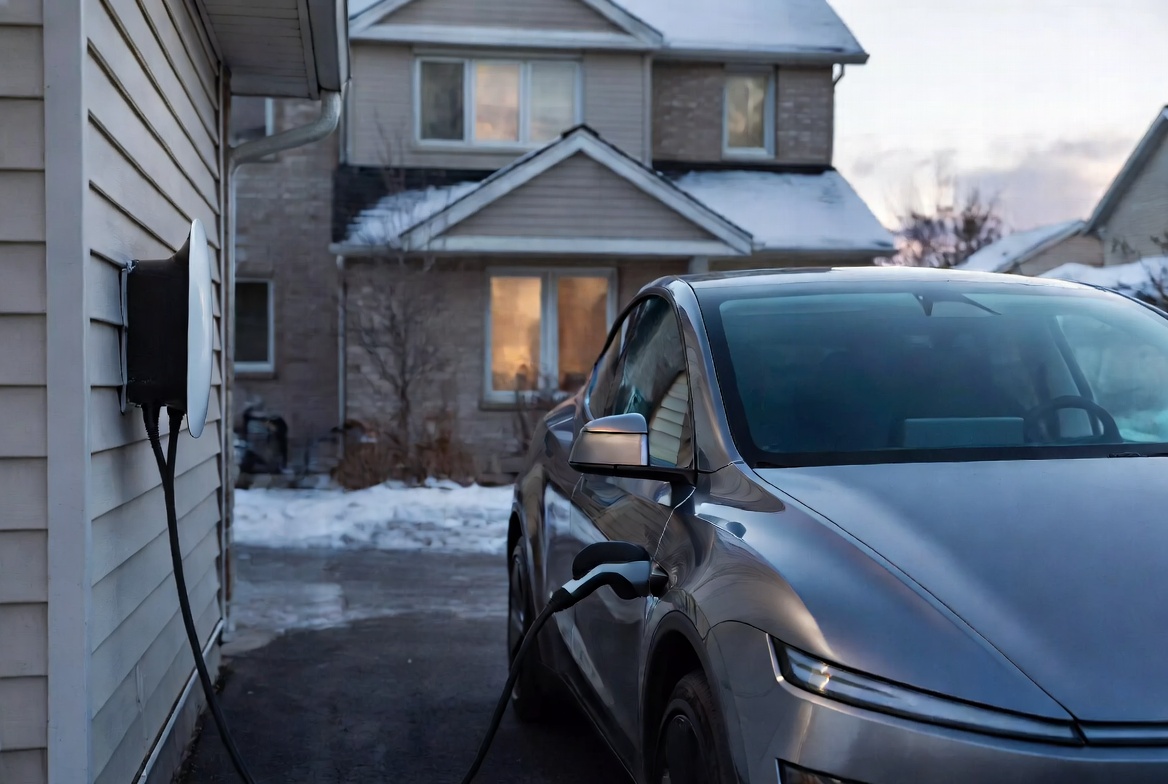
An EV charger installation in Toronto in 2026 costs $1,800 to $8,500+ fully installed depending on your existing electrical service, the cable run distance, and whether a 100A-to-200A panel upgrade is required. A standard Level 2 home install on an existing 200A panel runs $1,800 – $4,500; complex installs requiring a service upgrade run $4,500 – $8,500. Done right by a Licensed Electrical Contractor, the install pulls a mandatory ESA permit, takes 4 – 8 hours on site, and pays for itself within two to three years of avoided public charging fees.
This is the no-nonsense 2026 guide to home EV charger installation Toronto — what it actually costs, when you need a panel upgrade, the ESA permit and inspection process, the rebates still available in Ontario, and the mistakes that cost GTA homeowners thousands.
Why Country Renovations. Wiring Toronto and GTA homes since 2014. HCRA-registered, ECRA/ESA-licensed Electrical Contractor, WSIB-cleared, $5M general liability, and a fixed-price written quote within 5 business days of your free site visit — covering charger, panel work (if any), ESA permit, and final inspection. Book a free site visit →
Key Takeaways
- Simple installs (200A panel, charger near panel): $1,800 – $2,800 all-in, including charger, ESA permit, and inspection.
- Standard installs (longer cable run, exterior mount): $2,800 – $4,500 all-in.
- Complex installs (100A → 200A panel upgrade required): $4,500 – $8,500+ all-in.
- ESA notification is mandatory. Every hardwired EV charger install in Ontario requires an ESA filing by a Licensed Electrical Contractor before work begins, plus an ESA inspection after install.
- City of Toronto building permit: not required for a basic install. May trigger if exterior conduit penetrations or detached-garage trenching is involved, particularly in heritage-designated neighbourhoods.
- Ontario Ultra-Low Overnight (ULO) rate: ~2.8¢/kWh overnight in 2026 — a full 60 kWh charge costs about $1.70.
1. EV Charger Installation Cost in Toronto: What It Actually Costs in 2026
The cost of an EV charger installation Toronto homeowners pay depends mostly on your panel capacity and the distance from the panel to the parking spot.
In 2026, a typical home EV charger installation in Toronto lands in three cost zones depending on your existing electrical service:
- Simple installs (existing 200A panel, charger near the panel): $1,800 – $2,800 all-in.
- Standard installs (200A panel, longer cable run, exterior mount): $2,800 – $4,500 all-in.
- Complex installs (panel upgrade required, or older home with 100A service): $4,500 – $8,500+ all-in.
These numbers include the Level 2 charger ($600 – $1,400 for a quality unit), labour, conduit and wiring, the ESA permit ($120 – $220), and ESA inspection. They do not include drywall repair, trenching for detached garages, or load-calculation engineering for older homes — those are quoted separately and we flag them in your written estimate.
Two factors drive the spread: the distance from your electrical panel to the charger location, and whether your existing service can handle the new 40A or 48A circuit without an upgrade.
2. Level 1 vs Level 2 vs Level 3: Which EV Charger Installation Toronto Homeowners Actually Need
Toronto homeowners have three charging options. Only two are practical at home.
| Charger Level | Voltage / Amps | Range Added per Hour | Home Use? |
|---|---|---|---|
| Level 1 | 120V / 12A (standard outlet) | 6 – 8 km/hr | Backup only |
| Level 2 | 240V / 30 – 48A | 30 – 80 km/hr | ✅ Recommended |
| Level 3 (DC Fast) | 400V+ / 100A+ | 250+ km/hr | Commercial only |
Level 1 uses the regular 120V outlet that came with your car. Free to “install” but only adds 6 – 8 km of range per hour — fine for a plug-in hybrid, useless for a Tesla Model Y or Ford F-150 Lightning if you drive more than 40 km a day.
Level 2 is what almost every Toronto homeowner installs. A 240V circuit (the same voltage as your dryer or stove) running 30A to 48A delivers 30 – 80 km of range per hour. A full overnight charge from empty is realistic, even in a Scarborough or Mississauga winter where battery efficiency drops.
Level 3 (DC Fast Charging) requires 3-phase commercial power and runs $50,000+ to install. It’s not a residential product. If anyone quotes you a “Level 3 home install,” walk away.
The practical answer for 99% of GTA households: a Level 2 charger installation at 40A or 48A.
3. Cost Breakdown: Good / Better / Best (CAD 2026)
Real Toronto-area pricing based on Country Renovations 2025 – 2026 project data. All prices include charger, labour, ESA permit, and inspection.
| Tier | Total Installed (CAD) | Charger Class | Panel Work Assumed |
|---|---|---|---|
| Good | $1,800 – $2,800 | 32A Level 2 (ChargePoint Home Flex, Grizzl-E Classic) | None — existing 200A panel, charger within 5m of panel |
| Better | $3,200 – $5,200 | 40 – 48A Level 2 (Tesla Wall Connector, Wallbox Pulsar Plus) | New 40 / 60A breaker, 10 – 20m run, possible exterior mount |
| Best | $5,500 – $8,500+ | 48A hardwired Level 2 with energy management | 100A → 200A service upgrade, new main panel, Toronto Hydro coordination |
The “Best” tier looks expensive until you compare it to public DC fast charging at $0.45 – $0.65/kWh. A typical Toronto driver (15,000 km/year) saves $1,200 – $1,800 annually charging at home — meaning even the top tier pays back in 3 – 5 years.
4. Do You Need a Permit? (ESA Inspection + City of Toronto Requirements)
Yes — and here’s the part most homeowners get wrong.
In Ontario, every hardwired EV charger installation requires an ESA notification (often called an “ESA permit”) submitted to the Electrical Safety Authority before work begins. The ESA is the provincial regulator for electrical safety, and an inspection is mandatory after install.
What’s required:
- ESA notification filed by the Licensed Electrical Contractor (LEC) doing the work — not the homeowner.
- ESA inspection scheduled after the charger is wired but before drywall closes anything in.
- Pass certificate issued once the inspector signs off — keep this with your home records and your insurance file.
The City of Toronto does not require a separate building permit for a typical EV charger install (no structural work). However, if the install involves a panel upgrade, exterior conduit penetrations, or trenching across a property line to a detached garage, additional permits or zoning checks may apply — particularly in heritage-designated neighbourhoods or properties affected by an MZO under recent Bill 23-era zoning changes.
If your contractor tells you “no permit needed, we’ll just install it,” that’s a hard stop. An uninspected install can void your home insurance and creates personal liability the moment something fails.
What skipping the ESA notification actually costs
In Ontario an EV charger installation requires a Notification of Work filed with the Electrical Safety Authority before the work starts. It is filed by the Licensed Electrical Contractor doing the job, not by you. There is no grey area and no exemption for “it’s just one circuit.”
People skip it because a cash-job electrician offers to save them the fee. Here is what that saving is actually buying:
- Fines. Unpermitted work commonly attracts penalties reported in the range of $1,000 or more per occurrence, plus a surcharge on the permit fee when it is filed late. Penalties escalate considerably where unlicensed contracting is involved.
- A disconnection order. An inspector can require the circuit to be disconnected immediately, and it stays off until a Licensed Electrical Contractor corrects the work and it passes inspection. You are then paying twice for one charger.
- Insurance. If there is an electrical fire, the insurer investigates. Unpermitted high-voltage work discovered during that investigation is a standard basis for denying the claim — on a house fire, not just on the charger.
- Resale. A home inspector flags it, and you are retro-permitting under deadline pressure during a closing, which is the most expensive possible moment to do it.
The permit is a small line on the quote. Confirm current ESA requirements and fees directly with the Electrical Safety Authority, and make sure the Notification of Work number appears on your paperwork before the electrician leaves.
Ask for the ESA Notification of Work number in writing. A contractor who filed it can produce it in seconds. One who cannot did not file it.
5. When You Need a Panel Upgrade (and Why It’s Often the Hidden Cost)
The single biggest budget surprise on a home EV charger project is the panel upgrade for EV charger capacity.
Most older Toronto homes — anything built before the mid-1990s in neighbourhoods like the Beaches, East York, Etobicoke’s Alderwood, and parts of North York — have 100-amp electrical service. A modern Level 2 charger pulling 40A continuous load is allowed under the Ontario Electrical Safety Code (Section 8) only if a load calculation proves your existing service can handle it.
In practice, a 100A panel running central A/C, an electric dryer, and a typical kitchen often cannot support a 40A charger circuit safely. The fix is a service upgrade to 200-amp service, which involves:
- New main panel ($800 – $1,500 in materials)
- New service entrance cable from the meter
- Coordination with Toronto Hydro for the meter swap
- ESA inspection of the upgrade
Total panel upgrade cost in 2026: $2,800 – $4,800 depending on the home, plus the charger install on top.
A few signs you’ll likely need an upgrade:
- Your panel says “100A” or has fewer than 24 breaker slots.
- Breakers trip when the dryer and oven run together.
- The panel is a Federal Pioneer Stab-Lok or Zinsco — unsafe regardless of EV plans.
- You’re planning a heat pump, induction range, or hot tub in the next 5 years.
If you’re upgrading for an EV today, do it once and size for everything coming next. See our licensed electrical services.
The panel upgrade you may not need: load management (EVEMS)
This is the option that most often changes the budget, and most homeowners are never told it exists.
An Electric Vehicle Energy Management System monitors your home’s total electrical demand in real time and throttles or pauses the charger when the rest of the house is drawing heavily — when the dryer, oven and air conditioning are all running. Because the charger can never push the service over its limit, an EVEMS lets you add a Level 2 charger to a panel that a straight load calculation would otherwise reject. These systems are recognised under the Canadian Electrical Code, so this is a code-compliant route rather than a workaround.
The economics are straightforward: a service upgrade is one of the largest single line items in an EV charger project, and an EVEMS device typically costs a fraction of it. Your car charges slightly slower during peak household demand — on an overnight charge, usually not noticeable at all.
It is not always the right answer. If your service is genuinely undersized for the house you have, or you are planning a heat pump, a hot tub or a second EV, the upgrade is the better long-term spend. But you should be told which of the two you are buying, and why, before the panel upgrade goes on the quote.
Tesla Wall Connector: what’s different
The Tesla Wall Connector is hardwired rather than plugged in, and delivers up to 48 amps on a dedicated 60 amp circuit — roughly 11.5 kW, the fastest home charging most Ontario houses can practically support.
Three things worth knowing before you specify one:
- It can be commissioned below its maximum. If your service will not carry a 60 amp circuit, the unit can be set to a lower amperage during commissioning. You do not have to choose between a service upgrade and a different charger.
- Connector standard. In North America it uses Tesla’s connector. Non-Tesla EVs charge from it with the appropriate adapter, which matters if the household later adds a second vehicle of a different brand.
- Power sharing. Multiple units can share one circuit and divide the available current between them — relevant for two-vehicle households and for multi-unit properties.
The installation requirements are the same as any Level 2 charger: a Licensed Electrical Contractor, a load calculation, an ESA Notification of Work, and inspection.
6. Step-by-Step Installation Process
Every Country Renovations EV charger project follows the same five-step process so you know exactly what’s happening on each day:
- Free Site Visit (Day 1). Our licensed electrician inspects your panel, measures the cable run, confirms the mounting location (interior garage wall, exterior, or detached structure), and runs a load calculation per Section 8 of the Ontario Electrical Safety Code.
- Written Fixed-Price Quote (within 5 business days). You receive a line-itemed quote covering charger model, breaker, conduit, labour, ESA permit fee, drywall repair if applicable, and any panel work required. No “TBD” line items.
- ESA Notification + Scheduling. Once you approve, we file the ESA notification under our Electrical Contractor licence and book the install — typically within 1 – 2 weeks.
- Installation Day. A standard install is 4 – 8 hours on site. Panel upgrade installs run 1 – 2 days. We pull permits, coordinate with Toronto Hydro if a service upgrade is involved, and leave the site clean.
- ESA Inspection + Sign-off. The ESA inspector visits within 5 – 10 business days. We meet them on site, walk through the install, and hand you the pass certificate when it clears.
Get a real quote — not a guess. Country Renovations has been wiring Toronto homes since 2014. HCRA-registered. ECRA/ESA-licensed. WSIB-cleared. Book your free site visit →
7. Federal & Provincial Rebates Available in Ontario (2026)
The rebate landscape for residential EV charger installation in Ontario has narrowed since 2022, but several programs remain:
- Natural Resources Canada — ZEVIP (Zero Emission Vehicle Infrastructure Program): Primarily targets multi-unit residential buildings (MURBs), workplaces, and public chargers. Single-family homes are not the main focus, but condo corporations should check eligibility.
- Toronto Atmospheric Fund / Toronto Hydro pilots: Periodic rebate pilots have offered $200 – $600 toward home charger installs in specific neighbourhoods. Check Toronto Hydro’s current programs at the time of install — these come and go.
- Save on Energy programs (IESO): Look for time-of-use and ultra-low overnight (ULO) electricity rates. The ULO rate drops to roughly 2.8¢/kWh overnight in 2026 — meaning a full 60 kWh charge costs about $1.70.
- Greener Homes Loan: If your EV charger install is bundled with a heat pump, insulation, or other deep-energy-retrofit work, the federal Canada Greener Homes Loan (interest-free up to $40,000) may cover charger work as part of the project scope.
Federal point-of-sale rebates on the vehicle itself (the former iZEV program) ended in early 2025 and have not been reinstated as of this writing. Always confirm current rebate availability before relying on a number — programs change quarterly.
8. Common Mistakes That Cost Homeowners $$$
After a decade of installs across the GTA, these are the patterns we see when homeowners hire the wrong contractor:
- Skipping ESA notification. It’s not optional. An uninspected install can void your home insurance and creates seller-disclosure liability if you ever list the property.
- Undersized circuit. Some installers wire a 40A charger on a 30A breaker because “the car will only ever pull 30A.” Code requires breaker sizing matched to the charger’s continuous load. ESA fails this on inspection every time.
- Plug-in vs hardwired confusion. A NEMA 14-50 plug install looks cheaper but degrades over time and is rated for 50A intermittent, not continuous. For 40A+ chargers, hardwired is safer and code-preferred.
- Ignoring the panel. Installing a Level 2 charger on a fully-loaded 100A panel without a load calculation is the #1 reason for tripped main breakers in the first month.
- Hiring a handyman, not a Licensed Electrical Contractor. Only an LEC with an ECRA/ESA licence can legally pull the permit. If your installer can’t quote a 7-digit ECRA number, they can’t do the job.
- No written contract. Verbal quotes leave the homeowner exposed when “surprises” appear mid-install. Always insist on a fixed-price written contract.
9. Why HCRA-Registered Contractors Matter
A safe EV charger installation Toronto residents can rely on starts with a properly licensed and insured contractor.
The Home Construction Regulatory Authority (HCRA) is Ontario’s regulator for new home builders and vendors. While EV charger installation alone doesn’t trigger HCRA registration (that’s ESA’s domain), HCRA registration matters when your charger install is part of a larger renovation, addition, or new build — exactly the work Country Renovations specializes in.
When your EV charger work is bundled with a garage build, basement renovation, or home addition project, you want one HCRA-registered general contractor coordinating the electrical, structural, and permit work — not three trades pointing fingers at each other.
Country Renovations is HCRA-registered, holds an ECRA/ESA Electrical Contractor licence, maintains a current WSIB clearance, and carries $5M general liability insurance. All four are verifiable before you sign anything.
10. Frequently Asked Questions
How much does a Level 2 EV charger installation cost in Toronto in 2026?
A typical Level 2 charger installation in Toronto runs $1,800 – $4,500 all-in for homes with an existing 200A panel and a reasonable cable run. If a 100A-to-200A panel upgrade is required, total project cost rises to $4,500 – $8,500. Pricing includes the charger, ESA permit, labour, and inspection.
Do I need a permit to install an EV charger at home in Ontario?
Yes. Every hardwired EV charger install in Ontario requires an ESA notification (permit) filed by a Licensed Electrical Contractor before work begins, plus an ESA inspection after install. The City of Toronto does not require a separate building permit for a basic install, but panel upgrades and exterior penetrations may trigger additional approvals.
How long does the installation take?
A straightforward Level 2 install takes 4 – 8 hours on site. Installs that include a 100A-to-200A panel upgrade run 1 – 2 days, plus a Toronto Hydro meter swap window. ESA inspection is scheduled separately, typically 5 – 10 business days after install.
Can I install an EV charger myself?
Legally, no. Ontario’s Electrical Safety Code requires hardwired EV charger work to be performed by a Licensed Electrical Contractor (LEC) with an ECRA/ESA licence. A DIY install will fail ESA inspection, will not be insurable, and creates significant resale liability.
How do I know if my electrical panel can handle a Level 2 charger?
Your contractor must run a load calculation per Section 8 of the Ontario Electrical Safety Code, factoring in your existing major loads (A/C, dryer, range, water heater). Most 100A panels in older Toronto homes will not pass without a service upgrade. A 200A panel with under-50% existing load will usually accommodate a 40A charger circuit without issue.
Are there any rebates for EV charger installation in Ontario in 2026?
Federal point-of-sale rebates on the vehicle ended in early 2025. For chargers, NRCan’s ZEVIP program targets multi-unit and commercial sites, while occasional Toronto Hydro and IESO pilots offer modest rebates. The biggest ongoing saving is Ontario’s Ultra-Low Overnight (ULO) electricity rate, which drops home charging cost to roughly $1.70 for a full 60 kWh charge.
Hardwired charger or plug-in (NEMA 14-50)?
For 40A and 48A chargers, hardwired is safer, code-preferred, and avoids long-term degradation of plug contacts under continuous load. Plug-in installs are acceptable for 32A units but are not the right choice for higher-amperage chargers in Toronto’s climate.
Will an EV charger increase my home’s resale value?
Yes — and increasingly so as EV adoption rises across the GTA. A professionally installed, ESA-certified Level 2 charger is now a sought-after feature in detached and semi-detached listings in neighbourhoods like Leaside, Mimico, and Unionville. The pass certificate from ESA is what buyers’ lawyers want to see.
Ready to Plug In?
For most EV charger installation Toronto projects, working with a licensed, ESA-certified team keeps the job safe, code-compliant, and on budget.
Country Renovations has been installing EV chargers, panels, and full-service electrical across Toronto and the GTA since 2014. HCRA-registered. ECRA/ESA-licensed. WSIB-cleared. $5M insured. Book a free site visit and you’ll receive a written, fixed-price quote within 5 business days — covering the charger, the panel work (if any), the ESA permit, and the inspection.
Service area: Toronto core, Scarborough, North York, Etobicoke, Markham, Mississauga, Vaughan, Richmond Hill, Brampton, Oakville.
Related Country Renovations Services
- Licensed electrical services — full-service ESA-permitted electrical, panel upgrades, pot lights.
- Heated driveway Toronto — pair with EV charging for a winter-ready setup.
- Home additions & custom builds — bundle EV charger and garage builds.
- Renovations in Markham, Vaughan, Mississauga.
EV Charger Installation — GTA Service Areas
We deliver ev charger installation projects across the GTA. See city-specific cost, permit, and process notes:
- EV Charger Installation Markham
- EV Charger Installation Vaughan
- EV Charger Installation Mississauga
- EV Charger Installation Richmond Hill
- EV Charger Installation Oakville
- EV Charger Installation Brampton
- EV Charger Installation North York
- EV Charger Installation Etobicoke
- EV Charger Installation Scarborough
Trust & Compliance Resources for Ontario Homeowners
- HCRA Registered Contractor Ontario — Verification Guide (60-second builder verification, 7 red flags, 10 questions to ask)
- Tarion Warranty Ontario Explained (1/2/7-year coverage, claim process, deadlines)
- Bill 23 Toronto Homeowner Guide (multiplex zoning, second suites as-of-right, no parking required)
- Renovation Contract Red Flags Toronto (7 contract clauses to watch, milestone payment schedules)
See the work: completed projects and client reviews on our Houzz profile.