

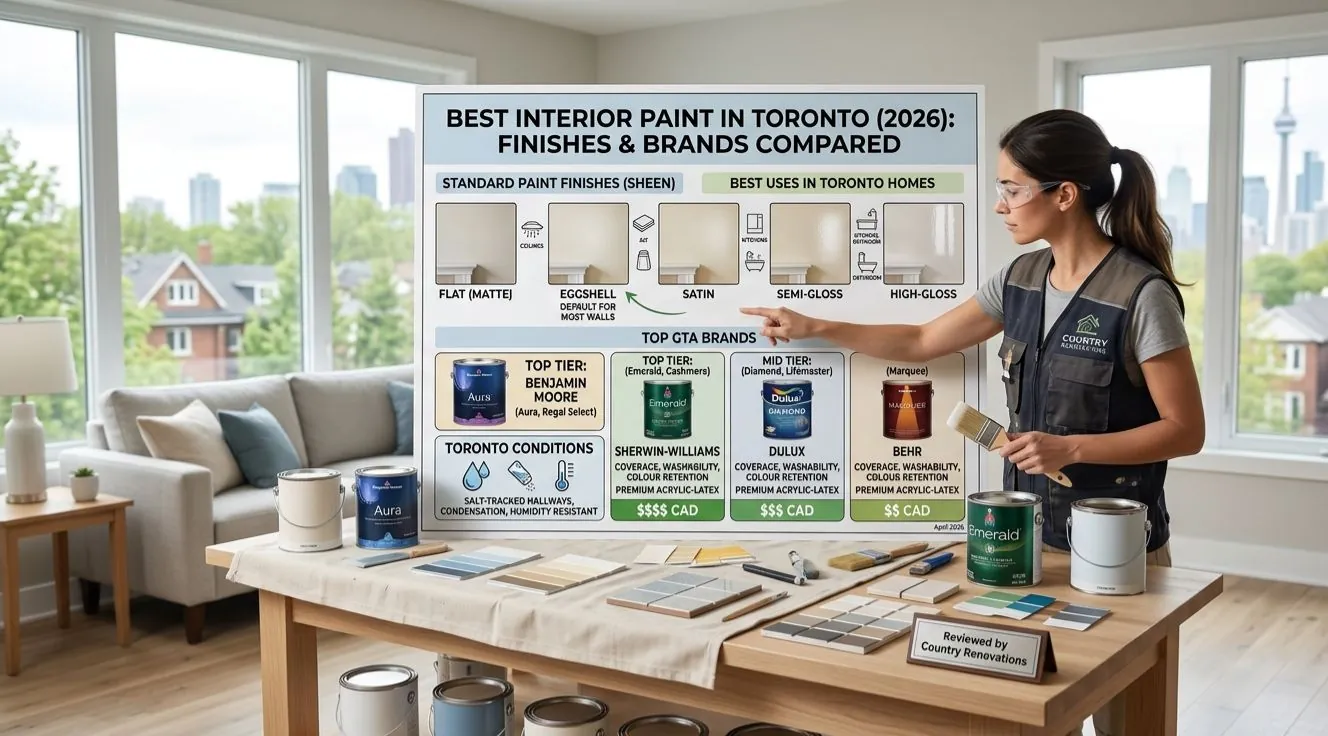
Direct answer. The best interior paints for Toronto homes in 2026 are Benjamin Moore Aura, Regal Select, and Sherwin-Williams Emerald for walls; Benjamin Moore Advance (waterborne alkyd) for trim and doors. These deliver long colour retention, scrubbable durability, and proper hide on the typical 2-coat application Toronto pros use.
Key Takeaways
- Walls: Benjamin Moore Aura (matte/eggshell) is the premium standard, at about $95 – $115 per gallon.
- Trim/doors: Benjamin Moore Advance — waterborne alkyd, hardens like oil, dries like latex.
- Kitchen/bath: scrubbable matte or eggshell finishes — Aura Bath & Spa has built-in mildew resistance.
- Cabinet repaint: Benjamin Moore Advance or Sherwin-Williams Emerald Urethane Trim Enamel — 60+ minute open time for spray application.
- Skip entry-level builder-grade lines for high-traffic rooms: they fade and scuff sooner and wash poorly.
Why Country Renovations. Building Toronto and GTA renovations since 2014. Licensed plumbing & electrical trade partners, $5M general liability insured, with WSIB-covered trades. Free written fixed-price quote in 5 business days. Book a free site visit →
The best interior paint Toronto homeowners can choose for most rooms is a premium acrylic-latex line in an eggshell finish for living areas, satin or semi-gloss for kitchens and bathrooms, and a flat finish for ceilings. For brands, Benjamin Moore Aura and Regal Select, Sherwin-Williams Emerald and Cashmere, and Dulux Diamond and Lifemaster lead the GTA market on coverage, washability, and colour retention.
Toronto homes get punished. Salt-tracked hallways, condensation-soaked window trim, basement humidity in July, dry winter air that splits caulking, and 30-degree temperature swings between rooms in the same week. Cheap paint shows it within a year. The right finish on the right surface, in a quality line, can hold up for eight to ten years—sometimes longer.
This guide answers the two questions GTA homeowners actually ask before they buy: which finish goes where, and which brand is worth the price. We’ll skip the marketing language and stick to what we see on real Toronto sites: where the gloss matters, and where it doesn’t.
Key Takeaways
- Flat for ceilings, eggshell for most walls, satin or semi-gloss for kitchens, bathrooms, trim, and doors. Gloss only for accent doors or feature trim.
- Benjamin Moore Aura and Sherwin-Williams Emerald are the top-tier choices in the GTA. Expect about $95 to $115 CAD per gallon, but you save a coat of labour on most jobs.
- Dulux Diamond and Behr Marquee are strong mid-tier picks for budget-conscious renos. Dulux sells through its own paint stores; Behr through Home Depot.
- In Toronto humidity (basements, bathrooms, condos near the lake), choose mildew-resistant lines like Aura Bath and Spa or Sherwin-Williams Emerald Urethane for trim.
- Premium paint costs more per can but cuts labour. The second coat you don’t need on Aura is worth $80 to $150 in painter time on a typical room.
Paint Finish 101: What Sheen Actually Means
A paint’s finish, also called sheen, is how much light it reflects. The scale runs from completely matte to mirror-shiny.
| Finish | Reflectivity | Best Used For | Toronto Example |
|---|---|---|---|
| Flat / Matte | 0–10% | Ceilings, low-traffic bedrooms, formal areas | A primary bedroom in a North York bungalow |
| Eggshell | 10–25% | Living rooms, dining rooms, hallways | Open-concept main floor in a Markham townhouse |
| Satin | 25–35% | Kids’ rooms, family rooms, light kitchens | A family room in a Brampton two-storey |
| Semi-gloss | 35–70% | Trim, doors, kitchens, bathrooms | Kitchen cabinets in a Scarborough semi |
| High-gloss | 70%+ | Accent doors, statement trim, furniture | Front door of a downtown Toronto rowhouse |
Want a painter who knows which finish your walls can handle? Our interior painting service handles surface prep, finish selection, and product spec for every room. We supply the paint; you keep the warranty.
Flat (Matte): Forgiving but Fragile
Flat paint hides flaws better than any other finish. On a ceiling, on a textured wall, on plaster that’s been patched five times, flat is the only forgiving option. It also looks rich. A modern matte interior reads more designed and more high-end than a shiny one, which is why most 2024–2026 paint trend reports keep pointing back to deep matte tones.
The catch: flat is the least durable finish. It scuffs, marks, and absorbs moisture more readily than any sheen above it. In a Toronto hallway with kids, dogs, or winter boots, a flat wall will need touch-ups within a year. Even premium “scrubbable” matte products like Benjamin Moore Aura Matte do better than older flats, but they still don’t beat eggshell on washability.
Use flat on ceilings, in formal living rooms, in low-traffic bedrooms, and on accent walls behind beds or sofas. Avoid it in kitchens, bathrooms, mudrooms, and main-floor hallways.
A common mistake we see in Toronto repaints: homeowners pick flat because it looks high-end in a magazine, then call us a year later when the same wall behind the dining chairs looks marked up. The room photo and the lived-in room are very different things.
Eggshell: The Default Wall Finish in Toronto
Eggshell is the workhorse of interior painting Toronto projects. If you’re not sure what to use, it’s almost always the right answer for living areas. It has just enough sheen to wipe down without burnishing, but not so much that it telegraphs every imperfection. Most quality interior painting jobs in the GTA spec eggshell on 70% or more of the wall surface.
Eggshell handles the realities of Toronto family life: light scuffs, occasional spills, kids’ fingerprints, the back of a chair scraping against a wall. A premium eggshell will let you wipe most of that off with a damp microfibre cloth and a drop of dish soap. Ten years in, with reasonable care, those walls still look right.
For an open-concept kitchen-living-dining layout, common in newer Mississauga and Vaughan builds, eggshell on the walls plus semi-gloss on the trim and doors is the standard professional spec. It reads as clean and consistent across rooms without the harsh transition you get when you switch sheens between rooms.
Satin: Use With Caution
Satin sits between eggshell and semi-gloss. It’s more washable than eggshell and softer-looking than semi-gloss, which sounds like the perfect compromise. In practice, satin is also the finish most likely to expose a bad paint job.
Roller marks, lap lines, brush strokes, and missed spots all show up more on satin than on eggshell. If your walls are anything less than perfectly smooth, satin reflects enough light to make the surface look uneven. When paint looks streaky, the answer is very often just that: wrong finish for that wall, or wrong technique for that finish.
Use satin in kids’ rooms, mudrooms, laundry rooms, and rec rooms where washability matters more than smoothness. Use it in kitchens only if the drywall is genuinely flat. Otherwise, eggshell with a quality cleaner does most of the same work without exposing the wall.
Semi-Gloss and High-Gloss: Trim, Doors, and Wet Rooms
Semi-gloss is the standard for interior trim, baseboards, casings, doors, and most kitchens and bathrooms. It cleans up almost anything, holds up to repeated wiping, and resists water and cooking grease. The light reflection also gives trim definition, which is especially helpful in white-on-white interiors that have become common in Toronto new builds.
For bathrooms, particularly in older Toronto homes with limited ventilation, semi-gloss with a mildew-resistant additive is the right call. Benjamin Moore Aura Bath and Spa is the gold standard here, formulated specifically for high-humidity rooms. Sherwin-Williams Emerald Interior in semi-gloss is a comparable alternative.
High-gloss is rarely used on full walls. It belongs on accent doors, statement front entries, fireplace mantels, or feature trim where you want a piece of the room to read like furniture. A black high-gloss front door on a Cabbagetown Victorian, for example, is a finish choice as much as a colour choice.
A common failure in older Toronto houses: flat paint in a bathroom with weak ventilation. Within a year or two the walls show water-spotting and mildew above the shower. The fix is to clean and treat the mildew, prime with a stain-blocking primer, and recoat in a mildew-resistant semi-gloss. Finish choice matters more than people think in Toronto’s wet rooms.
Trending Colours for 2025–2026 and What They Mean for the Paint You Buy
Recent colour forecasts from the major brands lean warm and deep. Benjamin Moore named Cinnamon Slate, a muted plum-brown, for 2025 and Silhouette, a deep espresso-charcoal, for 2026. Sherwin-Williams picked Universal Khaki for 2026. Across the forecasts, the shift is away from the cool greys of the last decade and toward earthy browns, warm whites, muted greens and soft plums.
Following a trend colour can change which product and finish you should buy:
- Deep colours are harder to hide with lower-tier paint. Dark shades are mixed in a deep or clear base with a lot of colourant. In mid-tier and budget lines, that often means an extra coat to get even colour. That extra coat is where the money goes.
- Use a tinted primer for big colour jumps. Going from builder white to a deep brown, or from a dark accent wall back to a warm white, is faster with a grey or tinted primer under the finish coats.
- Dark matte walls show wear sooner. Scuffs and burnishing show more on deep matte than on light colours. Burnishing means shiny patches where a wall gets rubbed. In hallways and around light switches, use eggshell or a scrubbable matte line.
- Check warm colours under your own bulbs. Warm whites and khakis can read yellow under 2700K LEDs and grey under 4000K. Test your sample at night with the lights you actually use.
- Keep the formula for touch-ups. Touch-ups on deep colours flash more than on light ones. Keep leftover paint from the same batch and photograph the label with the tint formula.
Planning a kitchen or bathroom reno? Finish selection is just one piece. Our kitchen renovation service and bathroom renovation service cover paint, tile, fixtures, and waterproofing as a single scope—no coordination headaches, one warranty.
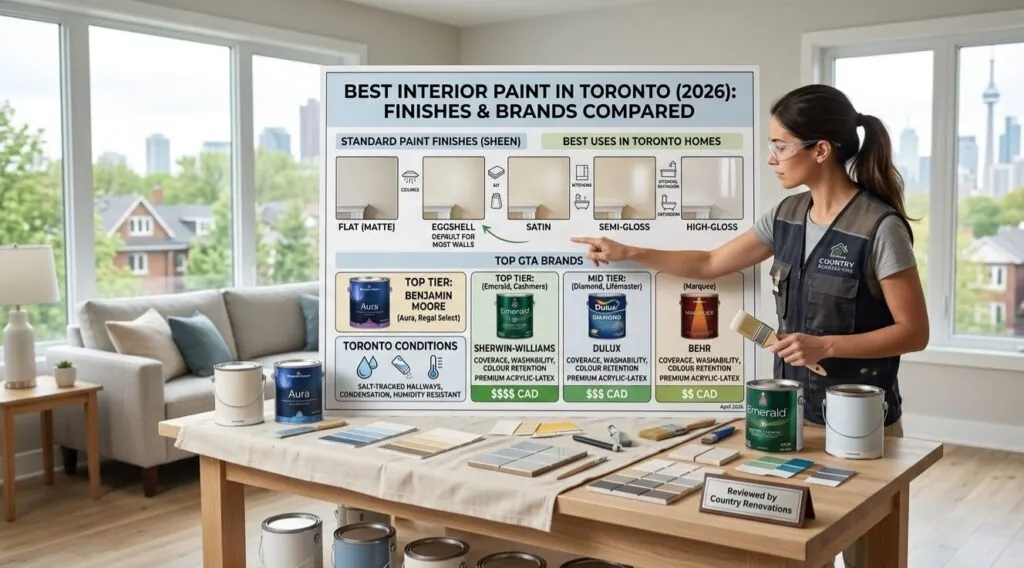
Brand-by-Brand: What’s Actually Worth Buying in the GTA
Paint quality is mostly about three things: solids content (how much real pigment and binder versus water), coverage per coat, and how the paint ages over time. Cheap paint has more water and less binder. It looks fine on day one. It fails on day 800. Premium paint is more expensive per can, but you typically save a coat, which means less labour, less time, and a longer-lasting result.
Below is how the major brands behind the best interior paint Toronto pros recommend actually perform on GTA jobs, sorted by tier.
Top Tier: Benjamin Moore and Sherwin-Williams
Benjamin Moore Aura is the most-spec’d premium paint among Toronto designers and high-end builders. It self-primes on most surfaces, often covers in one coat over a similar colour, and offers the best dark-colour saturation of anything on the market. Around $95–$115 CAD per gallon. Aura Bath and Spa is the bathroom variant. Aura Grand Entrance is a high-build exterior door product worth specifying for front doors.
Benjamin Moore Regal Select is the step down, at about $75–$85 CAD per gallon. Excellent coverage and durability, but without Aura’s one-coat magic on dark colours. The right choice for whole-home interior repaints when budget matters more than the absolute top spec.
Sherwin-Williams Emerald is Aura’s direct competitor and matches it closely on quality. It runs slightly less in Canadian pricing, around $90–$105 CAD per gallon. Emerald Urethane Trim Enamel for doors and cabinets is exceptional—harder cure than most water-based enamels and the closest you can get to oil-based durability without the cleanup headache.
Sherwin-Williams Cashmere is the mid-premium line. It has a softer, more velvety finish than most and is a great fit for bedrooms and dining rooms where you want a quieter look. Around $70–$85 CAD per gallon.
Mid Tier: Dulux, Para, and Behr Marquee
Dulux Diamond is the strongest mid-tier paint widely available in Canada. Around $55–$70 CAD per gallon. Coverage and durability are solid—not at the Aura level, but the price-to-performance is hard to beat.
Dulux Lifemaster is a contractor-grade line, often what builders and big-box trades default to. Acceptable, not premium. Use it for rentals, basement utility spaces, or anywhere the goal is a clean coat at the lowest reasonable cost.
Para Paints is a Canadian-developed line that holds up well in our climate. The Ultra and Premium lines are good. Para’s colour range leans toward muted, current tones that age gracefully.
Behr Marquee is Home Depot’s flagship and surprisingly competitive. Independent testing, including Consumer Reports’ paint ratings, has put Marquee at the top of multiple categories. Coverage in one coat on most colours is real. Around $55–$65 CAD per gallon. The downside: in our experience, Behr’s colour consistency between batches is not as tight as Benjamin Moore or Sherwin-Williams. If you’re painting a large open area, buy all your gallons at once and have them box-mixed.
Budget Tier: Builder-Grade Lines
Behr Premium Plus, Glidden, and the no-name contractor lines from any big box: these are fine for one purpose—getting paint on a wall fast. Use them in rental units, utility rooms, or spaces you’re going to repaint within three years anyway. Don’t use them on a kitchen, bathroom, or any wall you want to last a decade.
The trap with budget paint isn’t the can price; it’s the labour. A pro painter charges by the room or by the hour, and a cheap paint that needs three coats can cost more all-in than premium paint that needs one. On a 12-by-14 room, the difference between a one-coat and a three-coat job is around two extra hours of labour, often $120 to $200 at Toronto rates. The $30 you saved on the can is gone before you finish the room.
Head-to-Head: Dulux vs Behr vs Benjamin Moore vs Sherwin-Williams vs Glidden
Most brand comparisons put one brand's top line against another brand's entry line, which tells you very little. Compare like with like: flagship against flagship, and mid-line against mid-line.
The prices below are typical GTA shelf prices per gallon-size can before sales. They change with promotions and contractor pricing, so confirm at the counter. Can sizes also vary between brands, so compare price per litre when the numbers are close.
| Brand | Lines covered in this guide | Typical price per gallon (CAD) | Where it's sold in the GTA | Best fit |
|---|---|---|---|---|
| Benjamin Moore | Aura, Regal Select | $75–$115 | Independent Benjamin Moore dealers | High-visibility rooms, deep colours, wet rooms |
| Sherwin-Williams | Emerald, Cashmere | $70–$105 | Sherwin-Williams stores | High-visibility rooms, trim and cabinets (Emerald Urethane) |
| Dulux | Diamond, Lifemaster | $55–$70 (Diamond) | Dulux paint stores | Whole-home repaints on a budget |
| Behr | Marquee, Premium Plus | $55–$65 (Marquee) | Home Depot | DIY repaints, one-coat refreshes |
| Glidden | Glidden Premium | About $40–$55 | Home Depot and other mass retailers | Rentals, utility rooms, short-term refreshes |
| Beauti-Tone | Several lines, entry to premium | Varies widely by line | Home Hardware | Compare its top line only against other flagships |
Dulux vs Behr
The fair matchup is Dulux Diamond against Behr Marquee. They sit at similar prices, and both are solid mid-tier wall paints. For a single-room DIY refresh, either one will do the job.
The deciding factors are usually practical:
- Store access: Behr is only at Home Depot, which has long hours and frequent sales. Dulux sells through dedicated paint stores, where staff deal mainly in paint.
- Re-buying the same colour: On a large open-plan area, or a job you'll touch up for years, choose the brand you can easily re-buy in the exact same formula.
Behr Premium Plus against Dulux Diamond is not a fair comparison. Premium Plus is a tier down.
Glidden vs Benjamin Moore (and Glidden Premium vs Regal Select)
Glidden Premium usually costs a little over half the price of Benjamin Moore Regal Select. The gap shows on colour changes and high-traffic walls. A thinner film can mean an extra coat and less washability.
Glidden makes sense for closets, rentals and same-colour refreshes in low-traffic rooms. Regal Select earns its price on colour changes, hallways, kitchens and anywhere you expect to scrub. If the cheaper paint needs a third coat, most of the savings on the can disappear, as the labour math above shows.
Behr vs Beauti-Tone
Beauti-Tone is Home Hardware's house brand and is made in Ontario. Our "avoid" note at the top of this guide applies to its entry, builder-grade lines, not the whole brand.
For a fair comparison, put Behr Marquee against Beauti-Tone's top interior line. At that level, the practical question is often which store is closest when you need a matched top-up mid-project.
Dulux Diamond vs Sherwin-Williams Emerald
These paints are a tier apart. Emerald is Sherwin-Williams' flagship at roughly $90–$105 a gallon, while Diamond runs about $55–$70. The extra money mostly buys higher solids and better hide, which matters most with deep colours and rooms you'll wash often.
The fairer Sherwin-Williams comparison for Diamond is Cashmere. For a whole-house repaint in light-to-mid colours, Diamond is the value pick. For a dark feature room or a busy kitchen, Emerald justifies the price.
Picking the Best Interior Paint Toronto Has for Your Project
A simple decision framework that works for most GTA homes:
- Map the rooms by use. Dry kitchens, wet bathrooms, high-traffic hallways, low-traffic guest rooms—each one has a default finish.
- Identify the wall condition. Smooth new drywall handles any sheen. Old plaster, patched drywall, and textured walls all need lower sheen.
- Set a quality budget per room. Bathroom and kitchen: top-tier paint is worth it for moisture and cleaning resistance. Living room and bedrooms: mid-premium is fine. Closets and utility: contractor-grade.
- Match the brand to the use. Benjamin Moore Aura or Sherwin-Williams Emerald for the rooms you’ll see every day. Dulux Diamond for everything else. Trim and doors: Emerald Urethane or Aura Satin Impervo.
- Test a sample. Toronto light shifts dramatically from a south-facing condo on the lake to a north-facing semi in The Junction. Always paint a 2-by-2-foot sample on the actual wall and look at it morning, afternoon, and under your evening lighting before committing.
For a full guide on hiring the right pro to spec and apply the paint, see our piece on how to choose a renovation contractor in Toronto.
What Is Most Cost-Efficient? Paint Cost for One Room, Worked Out
Take a 12-by-14-foot bedroom with 8-foot ceilings:
- Wall area: (12 + 14) × 2 × 8 = 416 sq ft. Subtract about 40 sq ft for a door and window, which leaves roughly 375 sq ft.
- Coverage: Most interior wall paints are rated at about 350 to 400 sq ft per gallon per coat on smooth, primed drywall. Check the label for your product.
- Paint needed: About one gallon per coat for this room.
| Paint line | Price per gallon (CAD) | Wall paint for 2 coats | Wall paint for 3 coats |
|---|---|---|---|
| Benjamin Moore Aura | $95–$115 | $190–$230 | $285–$345 |
| Sherwin-Williams Emerald | $90–$105 | $180–$210 | $270–$315 |
| Benjamin Moore Regal Select | $75–$85 | $150–$170 | $225–$255 |
| Dulux Diamond / Behr Marquee | $55–$70 | $110–$140 | $165–$210 |
| Budget lines (Glidden Premium, Behr Premium Plus, entry lines) | $40–$55 | $80–$110 | $120–$165 |
At the same number of coats, budget and premium paint differ by about $90 to $150 for a full bedroom. The real question is whether the cheaper paint needs the same number of coats. Here is how that plays out in practice:
- DIY, same colour or a small shift: Mid-tier paint (Dulux Diamond, Behr Marquee, Regal Select) is usually the most cost-efficient choice.
- Big colour change or deep colour: Premium paint pays for itself if it saves a coat, whether that's your weekend or a painter's hours.
- Hiring a painter: Labour is the larger share of most professional jobs. The paint line affects the total mainly through the number of coats and how long the walls last before the next repaint.
- Sales: All the major brands run regular promotions. A flagship bought on sale can land close to a mid-tier line's regular price.
- The rest of the shopping list: Budget for primer on new drywall or patches, a separate ceiling paint, trim enamel, and good roller covers. A cheap roller sheds lint and puts down a thin coat, even with expensive paint.
Frequently Asked Questions
What is the best interior paint Toronto homeowners use most?
Eggshell is the most-used wall finish in GTA homes. It balances washability and forgiveness on imperfect walls, which suits both older Toronto plaster homes and newer drywall builds. Semi-gloss is standard for trim and doors.
Is Benjamin Moore really worth the extra cost in Canada?
For high-visibility rooms, kitchens, and bathrooms, yes. Benjamin Moore Aura typically covers in fewer coats than mid-tier paints, which saves labour cost on professional jobs. For closets, basements, or rentals, a mid-tier paint like Dulux Diamond is the better economic choice.
What’s the best paint finish for a Toronto bathroom?
Semi-gloss with a mildew-resistant additive, like Benjamin Moore Aura Bath and Spa or Sherwin-Williams Emerald Interior in semi-gloss. Older Toronto bathrooms with limited ventilation especially benefit from these formulations.
Can I mix brands on the same project?
Yes, and most pro jobs do. Use a top-tier brand on living areas, kitchens, and bathrooms, and a mid-tier brand on closets, utility rooms, and ceilings. Just don’t mix brands on the same wall—the slight base differences will show.
Should I use the same finish on ceilings and walls?
No. Ceilings should always be flat, even if walls are eggshell or higher. Flat ceiling paint hides drywall taping seams and prevents glare from overhead lighting. Specialty ceiling paint (like Benjamin Moore Waterborne Ceiling Paint) is purpose-built and worth the small upcharge.
Can I get a Benjamin Moore or Sherwin-Williams colour mixed in Behr or Dulux?
Yes. Most paint counters can computer-match a colour chip or another brand's colour code. The match is usually close but not identical, because each brand uses different bases and colourants. The difference shows most in deep colours and higher sheens. If you go this route, mix enough for the whole room at once and keep the printed formula for touch-ups. For an exact match to a named colour, buy it from the brand that created it.
Do I still need primer if the paint says “paint and primer in one”?
On sound, previously painted walls in a similar colour, usually not. You still need a separate primer in these cases:
- New drywall and fresh patches: A drywall primer seals the paper and compound so the finish coat doesn't look patchy.
- Water or smoke stains: Use a stain-blocking primer.
- Glossy surfaces or old oil-based trim: Use a bonding primer.
- Big colour jumps: A tinted primer saves a coat when going from very dark to light, or light to very dark.
Which paint brands do professional painters in the GTA use?
Benjamin Moore, Sherwin-Williams and Dulux are commonly specified on professional jobs, with Para and Behr also in use. Pros tend to choose brands based on practical factors:
- A contractor account
- A nearby store for same-day top-ups
- Consistent tinting between batches
When you compare quotes, ask which product line, not just which brand, is specified for walls, trim and ceilings, and get it in writing.
Is paint cheaper at big-box stores or at paint stores?
For the same quality tier, regular shelf prices are often similar. Big-box stores run frequent promotions on the brands they carry. Brand paint stores hold their own sales and offer contractor pricing. Compare the same tier, check the price per litre, and time larger purchases around a sale.
The Right Paint Choice Isn’t Just About Colour
Paint failure in Toronto homes is rarely about colour. It’s about finish chosen for the wrong surface, brand matched to the wrong budget, or prep that didn’t account for our humidity swings. The colour swatch is the easiest decision in the room. The finish and the product line are what determine whether that colour still looks good in five years.
For most GTA homeowners, the playbook for the best interior paint Toronto can offer is straightforward, and the best interior paint Toronto pros reach for is consistent across our project sites: flat ceilings, eggshell on living-area walls, satin in kids’ rooms, semi-gloss on trim and wet rooms, and a quality brand (Benjamin Moore, Sherwin-Williams, or Dulux Diamond) wherever you’ll see it daily. Spend the extra on bathrooms and kitchens. Save on closets and utility space.
If you’re planning a full repaint or a renovation that includes painting, get a quote from a contractor who specs the paint up front. Country Renovations has been painting GTA homes since 2014—fully insured, and matched to the surface conditions of Toronto’s housing stock, from 1920s plaster downtown to 2024 drywall in Vaughan. Request a painting quote and we’ll walk through finishes, brands, and prep on your specific rooms before any roller hits a wall.