

Direct answer. Energy-efficient home renovations in Toronto in 2026 typically cost $15,000 – $80,000+ for a comprehensive package (heat pump, insulation, windows, air-sealing). The federal Canada Greener Homes Loan provides up to $40,000 interest-free, paying back over 6 – 10 years through utility savings.
Key Takeaways
- Cold-climate heat pump (replaces furnace + AC): $12,000 – $25,000 — eligible for Greener Homes Loan.
- Attic insulation R60 upgrade: $2,500 – $6,500 — single highest-ROI energy retrofit.
- Wall insulation (blown cellulose into 2×4 walls): $3,500 – $9,500.
- Window replacement (whole home): $20,000 – $50,000 — Energy Star Most Efficient rated for max rebate.
- Hybrid heat-pump water heater: $3,800 – $6,200 — eligible for Greener Homes Loan + utility savings.
Why Country Renovations. Building Toronto and GTA renovations since 2014. HCRA-registered, licensed plumbing & electrical trades, WSIB-cleared, $5M general liability insured. Free written fixed-price quote in 5 business days. Book a free site visit →
Energy Efficient Home Renovation in Toronto (2026 Guide)
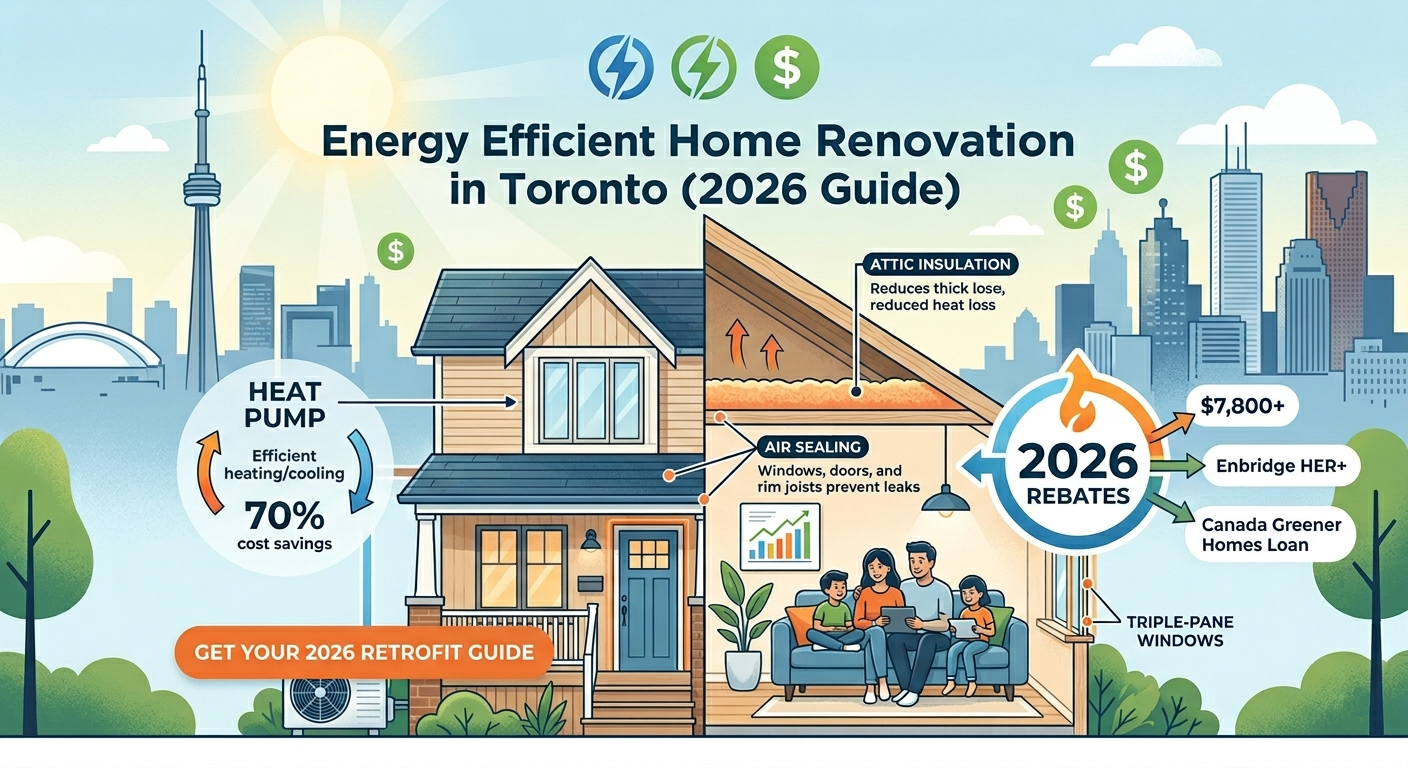
The highest-return energy efficient home renovation Toronto homeowners can do in 2026 is an air-source heat pump paired with attic insulation upgrades, which together typically cut heating and cooling bills by 30 to 50 percent and qualify for up to $7,800 in combined Enbridge and federal rebates. Window replacement, basement insulation, and air sealing follow as the next-best-ROI upgrades for most GTA homes.
A century-old semi in Riverdale and a 1980s detached in Mississauga share the same problem. They were built when natural gas was cheap, insulation codes were minimal, and nobody worried about a polar vortex. Today they leak heat through every uninsulated rim joist, single-pane window, and unsealed attic hatch. Toronto homeowners are now staring at $400 to $600 monthly winter gas bills and asking the same question: where does the renovation money actually pay off?
This energy efficient home renovation Toronto guide walks through what works, what doesn’t, and what 2026 rebates Toronto homeowners can stack to bring an energy retrofit within budget. We’ll cover the upgrades in order of return on investment, not in order of what’s most fashionable.
Key Takeaways
- Heat pumps and attic insulation are the two highest-ROI upgrades for most Toronto homes, with combined rebates up to $7,800 in 2026.
- The Canada Greener Homes Loan offers up to $40,000 interest-free for qualifying retrofits, and Enbridge’s Home Efficiency Rebate adds project-specific top-ups.
- A pre-retrofit EnerGuide evaluation (about $400 to $600) is required for federal funding and identifies your home’s biggest losses.
- Window replacement is high-impact but slow-payback; expect 15 to 25 years to break even on energy savings alone, so justifying it usually requires comfort or aesthetics too.
- Air sealing and basement insulation are the cheapest dollar-per-savings upgrades, often paying back in 3 to 5 years.
Start With an Energy Audit, Not a Wishlist
Most GTA homeowners begin energy renovations with a guess: new windows, new furnace, or a tankless water heater. The right starting point is a measured evaluation of where the home actually loses energy. A registered EnerGuide energy advisor (find one through Natural Resources Canada at nrcan.gc.ca) does a blower-door test, thermal imaging, and a full heat-loss model.
The audit costs about $400 to $600 in the GTA. It pays for itself two ways. First, it tells you the actual leak points, often surprising. Second, the federal Canada Greener Homes Initiative requires a pre-retrofit and post-retrofit audit to qualify for grant or loan funds. No audit, no rebate.
When the Chen family in North York booked an audit before their 2024 retrofit, they assumed their drafty old windows were the main problem. The blower-door test showed the bigger leak was a completely uninsulated attic hatch and a dozen unsealed pot lights in the second-floor ceiling. Sealing those, plus blowing in more attic insulation, cost $3,200. The energy savings exceeded what new windows would have delivered for $25,000. The audit redirected the entire project budget.
The 2026 Rebate Stack: What Toronto Homeowners Can Actually Get
Federal, provincial, and utility rebates change frequently, but the 2026 stack for Toronto homeowners includes:
| Program | Maximum | Eligible Upgrades | Notes |
|---|---|---|---|
| Canada Greener Homes Loan | $40,000 interest-free | Heat pumps, insulation, windows, doors, solar | Requires EnerGuide audit |
| Canada Greener Homes Grant (where still active) | Up to $5,000 | Heat pumps, insulation, air sealing | Status varies, check current intake |
| Enbridge Home Efficiency Rebate Plus | Up to $10,000 | Insulation, air sealing, windows, heat pumps, smart thermostats | Requires Enbridge gas account and audit |
| City of Toronto Home Energy Loan Program (HELP) | $125,000 at low interest | Major retrofits | Loan repaid via property tax |
Most homeowners stack the Enbridge HER+ with the federal Greener Homes Loan. A typical retrofit—attic insulation, basement insulation, air sealing, and a cold-climate heat pump—can pull in $7,000 to $12,000 in combined rebates plus an interest-free loan covering the remainder.
For up-to-date amounts and eligibility, check Enbridge HER+ and the federal Canada Greener Homes Initiative. Programs do change with each federal budget cycle.
Planning a retrofit and want a contractor who builds the rebate paperwork into the project? Country Renovations coordinates EnerGuide audits, eligible-product specs, and the post-retrofit verification as part of the scope. Talk to our team before you book the audit—the order matters for some rebates.
Heat Pumps: The Single Biggest Move You Can Make
Replacing a gas furnace and central AC with a cold-climate air-source heat pump is the highest-impact energy retrofit available to Toronto homeowners. A modern cold-climate heat pump (look for the CSA SPL standard certification) maintains efficient operation down to about minus 25 degrees Celsius, which covers the vast majority of GTA winter conditions. Below that, a small backup heat source kicks in.
In Toronto, a properly sized heat pump replacing a 90% efficient gas furnace typically cuts annual heating cost by 25 to 45 percent at current rates, and replaces your AC at the same time. Installed cost for a 3-ton cold-climate system: $14,000 to $22,000, before rebates. Rebates can take that effective cost down to $8,000 to $15,000.
The catch most homeowners miss: a heat pump needs the right electrical capacity. Older Toronto homes on 100-amp service often need a panel upgrade to handle a heat pump, an EV charger, and an induction range together. Budget another $2,500 to $4,500 for a 200-amp upgrade if you’re on the older grid. Our licensed electrical services team handles panel upgrades as part of full retrofits, including the ESA permit.
Hybrid systems—where the heat pump handles 80% of the year and a smaller gas furnace handles the coldest weeks—are a popular middle path for Toronto homes that can’t easily upgrade their panel or where ductwork sizing limits a full electric switch.
Insulation: Where the Cheapest Dollars Save the Most
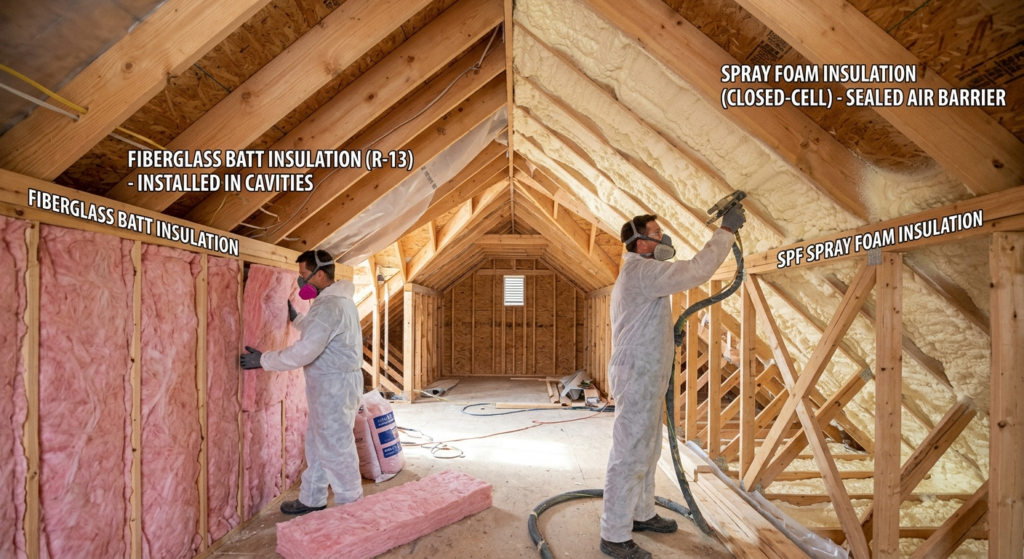
If a heat pump is the single biggest move, insulation is the most cost-effective. Most pre-2000 Toronto homes have R-20 or less in the attic, when current Ontario Building Code aspirations target R-60 for new builds. Bringing an attic from R-20 to R-60 costs about $2,500 to $4,500 for a typical Toronto detached or semi, and pays back in 4 to 7 years through heating and cooling savings.
Priority order for Toronto insulation upgrades:
- Attic. Heat rises. An underinsulated attic is the biggest loss in most GTA homes. Blown-in cellulose or fibreglass to R-60. Don’t forget to seal and insulate the attic hatch.
- Basement walls and rim joists. A typical Toronto basement leaks more heat than people expect. Spray foam on the rim joist and rigid foam plus framing on the walls, getting to R-20 effective, is a strong return.
- Above-grade walls. Hardest and most expensive. Usually only addressed during a re-cladding or major reno. Dense-pack cellulose injected into wall cavities is an option for older homes with empty stud bays.
- Bonus rooms and additions over garages. Notorious for cold floors. Often poorly insulated below the subfloor. Spray foam fixes most of them.
For homeowners doing a basement renovation anyway, the marginal cost of getting basement walls to R-20+ during the framing stage is small, often $1,500 to $3,000 added to the project. Doing it as a retrofit later, with finished walls in the way, costs three to four times as much.
When the Velasquez family in Scarborough did their basement legal apartment conversion last fall, we added 2 inches of rigid foam plus a stud wall with batt insulation to every below-grade exterior wall. Total upcharge: $2,800. The first winter, their main-floor furnace ran 22 percent fewer hours than the previous year. Same furnace, same thermostat schedule, just a warmer building shell.
Windows: High Impact, Slow Payback
Windows are the most visible energy upgrade and the most over-prioritized. New triple-pane windows do reduce heat loss, improve comfort, and quiet a noisy street. They also rarely pay for themselves on energy savings alone.
A typical Toronto detached home has 12 to 18 windows. Replacing all of them with quality triple-pane casements runs $30,000 to $60,000. The energy savings, depending on what you’re replacing, are usually $400 to $900 per year. That’s a 35 to 100 year payback on energy alone. The math improves with rebates and if comfort, draft, sound, or appearance is part of the value.
When window replacement does make sense:
- Single-pane or aluminum-frame windows from before 1990
- Failed seals (visible fogging between panes)
- A planned re-side or major envelope reno
- Comfort issues (cold drafts on a sofa next to the window)
- A renovation that’s already opening up wall surfaces
Skip whole-home window replacement as a standalone energy project. If budget is tight, replace the worst 3 to 5 windows in the most-used rooms and put the rest of the money into insulation or a heat pump.
Air Sealing: The Most Overlooked Upgrade in an Energy Efficient Home Renovation Toronto Project
Air leakage accounts for 25 to 40 percent of heat loss in older Toronto homes. The leaks are everywhere: rim joists, attic hatches, around plumbing penetrations, dryer vents, electrical boxes on exterior walls, and the gaps where the framing meets the foundation. Sealing them with caulk, spray foam, weatherstripping, and gasketing is unglamorous, low-cost work that delivers an outsized return.
A professional air sealing pass on a typical 2,000-square-foot Toronto home costs $1,500 to $3,500. The energy savings, particularly when paired with insulation upgrades, often pay it back in 3 to 5 years. The blower-door test from the EnerGuide audit identifies the worst leaks before any work starts, and a re-test after confirms the improvement.
Air sealing isn’t optional alongside insulation either. Adding R-40 to an attic that still has open chases and unsealed pot lights is partial work. The warm air bypasses the insulation entirely. Always seal first, then insulate.
Smaller Wins: Heat Pump Water Heater, Smart Thermostat, LED
Three smaller upgrades round out a typical Toronto retrofit:
Heat pump water heater. Replaces a gas tank water heater with an electric unit that uses 60 to 70 percent less energy than a standard electric heater. Best installed in a basement utility room with enough air volume. Installed cost: $4,500 to $6,500. Rebates available through Enbridge HER+.
Smart thermostat (ENERGY STAR certified). A $250 thermostat plus professional install can deliver 8 to 12 percent heating savings through smarter setbacks. Pairs especially well with heat pumps, which prefer steady temperatures over big setbacks.
LED lighting throughout. Self-evident, but worth confirming. Replacing remaining halogen pot lights, incandescent fixtures, and old CFLs with LED reduces electrical draw by 70 to 90 percent on those fixtures. Bundle the swap with a pot light installation job for the labour efficiency.
Want one quote that bundles audits, retrofits, and rebate paperwork? Get a single scope from a contractor who’s done it before. Request a retrofit consultation and we’ll lay out what your specific Toronto home needs, with rebate values built into the budget from day one.
Sequencing Your Energy Efficient Home Renovation Toronto Project: The Order Matters
A common mistake in any energy efficient home renovation Toronto project is doing the right upgrades in the wrong order. The right sequence for an energy efficient home renovation in Toronto:
- Audit first. Pre-retrofit EnerGuide audit. This unlocks rebates and identifies real leak points.
- Air seal. Cheapest, highest use. Always before insulation.
- Insulate. Attic, basement, then walls if accessible.
- Right-size mechanicals. Only after the envelope is tightened. A heat pump sized to a leaky house is too big once the house is sealed.
- Install the heat pump. With panel upgrade if needed.
- Replace worst windows. Targeted, not whole-house, unless aesthetics demand otherwise.
- Smaller upgrades. Smart thermostat, water heater, LEDs.
- Post-retrofit audit. Required to claim federal rebates and verify the savings.
Doing it in this order avoids the worst trap in retrofits: oversizing a furnace or heat pump for the leaky-house version, then watching it short-cycle inefficiently after you tighten the envelope.
Frequently Asked Questions
How much does an energy efficient home renovation in Toronto cost?
A whole-home energy retrofit in Toronto typically costs $40,000 to $90,000 before rebates. After stacking Enbridge HER+, Canada Greener Homes Loan, and federal grants, out-of-pocket cost can drop to $20,000 to $55,000 depending on home size and starting condition.
What’s the most cost-effective energy upgrade for a GTA home?
Air sealing and attic insulation are the cheapest dollar-per-savings upgrades. A combined air sealing and attic insulation project usually costs $4,000 to $7,500 and pays back in 4 to 7 years through utility savings, before any rebate.
Are heat pumps actually effective in Toronto winters?
Yes. Modern cold-climate heat pumps (CSA SPL-rated) maintain rated capacity down to about minus 25 degrees Celsius, which covers the vast majority of Toronto winter conditions. Below that, supplemental heat (electric strip or a small gas furnace) covers the gap. Most GTA homes need backup heat for fewer than 50 hours per year.
Do I need an EnerGuide audit to qualify for Toronto rebates?
For most major rebates, yes. The Canada Greener Homes Loan and Enbridge Home Efficiency Rebate Plus both require pre and post EnerGuide audits performed by a Natural Resources Canada-registered energy advisor. The audit cost is partially reimbursed by some programs.
Can I do these upgrades during a regular renovation?
Yes, and you should. Insulating during a basement reno or kitchen reno costs a fraction of doing it as a standalone retrofit. Wall insulation, in particular, is best added when finishes are already coming off. Always raise the energy upgrade conversation in your scope-of-work meeting.
How long does a full Toronto energy retrofit take?
Most full retrofits take 3 to 6 weeks of active work, spread over 2 to 4 months when audits, rebates, and equipment lead times are factored in. You can stay in the home for most of it, with brief disruption during heat pump installation and major insulation work.
The Renovation That Pays You Back Every Month
An energy efficient home renovation Toronto homeowners take on is one of the rare home improvements where the math actually works. Every month after the project, your gas and hydro bills are smaller. Every cold snap, your house holds heat that used to escape through the rim joist. Every rebate dollar you didn’t claim was money the federal and provincial governments were holding for you.
The order matters. Audit first, seal second, insulate third, mechanicals fourth, windows last. Skip the audit and you skip most of the rebates. Replace the furnace before sealing the envelope and you’ll oversize it for the version of the house that won’t exist by month six. Layer the upgrades right and a typical GTA semi can cut its energy use by 40 to 60 percent.
Country Renovations has been doing full-scope energy retrofits across Toronto and the GTA since 2014—licensed, insured, HCRA-registered, and experienced with the EnerGuide and rebate-paperwork side of these projects. Request a retrofit quote and we’ll walk through your specific home’s biggest losses before any tools come out.
Leave a Reply
You must be logged in to post a comment.