

Direct answer. A legal basement apartment in Toronto in 2026 typically costs $85,000 – $300,000 to build from scratch (or $25,000 – $62,000 to legalize an existing unit) and takes 4 – 6 months from first design meeting to first tenant. The unit must satisfy three independent regulatory regimes simultaneously: Toronto Zoning By-law 569-2013, the Ontario Building Code (OBC), and the Ontario Fire Code (OFC) Section 9.8. Under Bill 23 (More Homes Built Faster Act, 2022), a basement second suite is now permitted as-of-right in most Toronto residential zones — no Committee of Adjustment minor variance required.
Key Takeaways
- Bill 23 unlocks as-of-right second suites in detached, semi-detached, and townhouse dwellings across Toronto (and the GTA) — no parking required for the second unit, no development charges, no parkland fees.
- OBC Section 9.5.3.1 mandates 1.95 m ceiling height across at least 75% of habitable floor area — the most common dealbreaker in pre-1960 Toronto homes.
- OBC 9.9.10.1 requires bedroom egress windows of ≥0.35 m² with no dimension under 380 mm; sill no more than 1.5 m above the floor.
- OBC 9.10.9.14 requires 30-minute fire-resistance separation between dwelling units (45 minutes without sprinklers).
- Cost reality: $85K – $130K for a code-minimum build, $150K – $200K for mid-range, $250K – $300K+ when underpinning is required.
- ROI: a $173,500 mid-range unit renting at $2,150/month delivers ~$21,600/year net and adds $180K – $240K to resale value.
2026 update — Bill 23 and Toronto Multiplex Zoning. Toronto operationalized Bill 23 in 2023 through the Multiplex Study and amendments to By-law 569-2013, allowing up to four units as-of-right in most low-rise residential zones (RD, RS, RT, RM). Your basement second suite is typically the second of those four units. HCRA registration applies when the work crosses into substantial-addition or new-build territory; Tarion enrollment covers qualifying additions and new builds with statutory 1-year, 2-year, and 7-year warranty coverage.
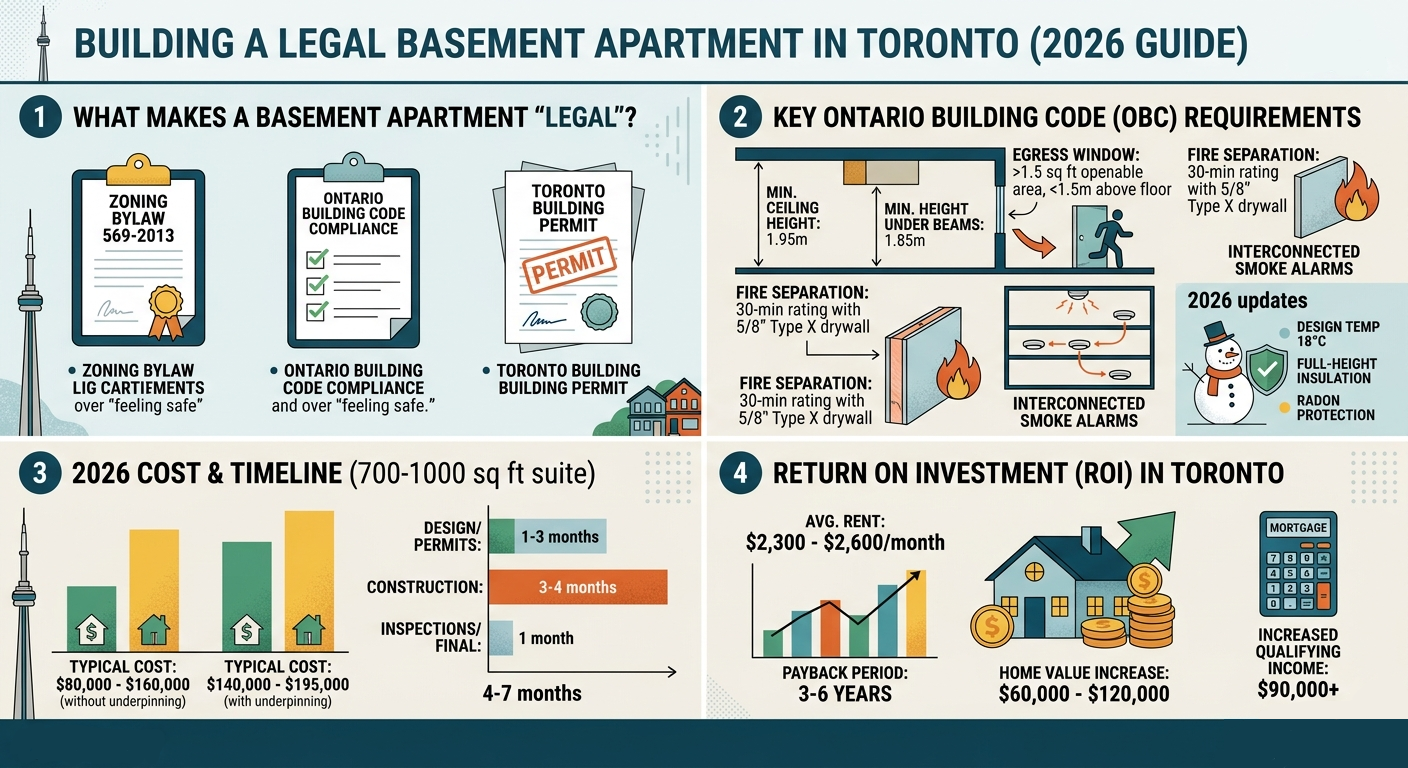
A legal basement apartment in Toronto must meet Ontario Building Code requirements for ceiling height (1.95 metres), fire separation, egress windows, and interconnected smoke alarms, and it must comply with Toronto Zoning Bylaw 569-2013 under a Toronto Building permit. In 2026, a typical 700–1,000 sq ft legal suite costs $80,000 to $160,000 and takes four to seven months from first permit sketch to final inspection.
Every week we get the same phone call. A homeowner in Scarborough or North York has an “apartment” in their basement that their uncle built in 2012, or a real estate agent just told them their planned rental income makes the unit “illegal retail,” or their insurance company flagged the suite after a routine inspection. Most of these homeowners don’t realize how close they are to being one fire-code violation away from losing the income, the insurance, or both.
The good news: building a legal basement apartment in Toronto in 2026 is more achievable than it has been in a decade. The city expanded multiplex zoning in 2023, the Ontario Building Code updated in March 2026, and Toronto rents for basement units now sit at $2,300 to $2,600 per month. This guide walks through every step, every rule, and every real number so you can decide whether the project makes sense for your property.
Key Takeaways
- A legal basement apartment in Toronto must comply with the Ontario Building Code and Toronto Zoning Bylaw 569-2013, not just “feel safe” to live in.
- Expect a 2026 cost of $80,000 to $160,000 for a 700 to 1,000 sq ft suite. Add $40,000 to $80,000 if underpinning is required for ceiling height.
- March 31, 2026 OBC updates require an 18°C basement design temperature, full-height insulation, and radon protection for new work.
- Permit approval runs two to four weeks for straightforward applications and two to three months for complex ones. Total project timeline: four to seven months.
- Typical Toronto basement apartment rents of $2,300 to $2,600 monthly produce a three to six year payback on most projects.
What Makes a Basement Apartment “Legal” in Toronto?
A basement apartment is legal in Toronto when three things are true at the same time. The property is in a zoning category that permits a secondary suite (or qualifies under the city’s multiplex bylaw). The suite meets every requirement in the Ontario Building Code for a separate dwelling unit. The work was completed under a Toronto Building permit and passed a final inspection.
If any one of those three is missing, the suite is illegal regardless of how nice it looks.
Secondary suite vs. Additional Residential Unit (ARU)
You’ll see both terms used interchangeably online. Technically, a “secondary suite” is the Ontario Building Code language for a self-contained dwelling unit within a house. An “Additional Residential Unit” (ARU) is the broader planning term that includes secondary suites, laneway houses, and garden suites. For the purpose of a basement apartment, the terms point to the same thing: a permitted, code-compliant, independent dwelling inside an existing residential property.
Why Toronto cracks down on illegal units
The city runs roughly 6,000 to 8,000 zoning and property standards investigations a year, and unpermitted basement suites are a common trigger. Consequences include orders to vacate the tenant, mandatory work orders to either legalize or demolish the unit, fines that start at $1,000 and can climb to $50,000 per violation, and insurance voidance in the event of a claim. The rental income disappears. The risk does not.
2026 Code Updates You Need to Know
Two regulatory changes landed in early 2026 and both affect basement apartment projects.
February 16, 2026: New Toronto Building permit application form. All building permit applications now use an updated digital form submitted through the Toronto Building Online portal. Paper submissions are no longer accepted for residential permits, and incomplete digital submissions are the leading cause of permit delays this year.
March 31, 2026: Ontario Building Code amendments. The updated OBC lowered the basement design temperature from 22°C to 18°C, requires full-height insulation on basement walls (slab to subfloor), and introduces new radon protection requirements for new dwelling units. If you pull a permit after March 31, 2026, your designer must show compliance with all three.
In practical terms: an older set of drawings your cousin prepared in 2023 is no longer permittable in 2026. You need a BCIN-registered designer, architect, or professional engineer to produce drawings that meet the current code.
Toronto Zoning: Can Your Property Even Qualify?
Before you spend a dollar on design, confirm the zoning. Toronto Zoning Bylaw 569-2013 governs what can be built where.
Zoning Bylaw 569-2013 in plain language
Most detached, semi-detached, and townhouse properties in Toronto are in an “R” (residential) zone that permits a secondary suite as-of-right. That means no special approval is needed provided the unit meets code. Condos, apartment buildings, and some commercial-residential mixed zones do not permit secondary suites in the basement.
To check your zoning, search your address on the City of Toronto’s Zoning Bylaw interactive map. The zone code (for example, RD, RS, RT, RM) tells you what is permitted.
Multiplex as-of-right: the 2023 change
In May 2023, Toronto amended Bylaw 569-2013 to allow up to four residential units on most low-rise residential lots as-of-right. This was a structural shift. A detached home on a typical Toronto lot can now contain a main-floor unit, an upper unit, a basement unit, and a laneway or garden suite, all without a rezoning application. The basement apartment does not have to be “secondary” to anything; it can be one of four peers.
Practically, this opened the door for homeowners to combine a basement suite with a laneway house or attic conversion as part of a larger plan. The zoning is in place. The building code still applies fully to each unit.
When you need a Committee of Adjustment variance
Some projects still require approval beyond the as-of-right zoning: lots smaller than the permitted minimum, side-yard setback issues with a new entrance, insufficient parking where required, or any project in a heritage conservation district. A Committee of Adjustment application adds three to six months and roughly $1,500 to $5,000 in fees.
Ontario Building Code Requirements (Checklist)
The Ontario Building Code, Part 9.5, sets the minimum standards for a legal basement apartment. Every requirement below is non-negotiable; inspectors will fail the unit on any single miss.
Ceiling height
A legal basement apartment needs a minimum finished ceiling height of 1.95 metres (6 feet 5 inches) throughout the living space. Under beams, ducts, or stairs, the allowance drops to 1.85 metres (6 feet 1 inch). If your current basement is under 1.95 metres, you have two options: underpinning (lowering the floor by excavating under the footings) or bench footing (building a stepped bench inside the foundation to avoid excavating underneath). Both are structural work requiring an engineer and dedicated permits.
Egress windows
Every bedroom in a legal basement apartment needs a window that opens to the outside without tools. The clear opening must be at least 1.5 square metres (about 16 sq ft), and the bottom of the window (sill) cannot be higher than 1.5 metres above the floor. A standard basement slider does not meet this. Most basement apartments need a proper egress window installed into a poured-concrete well, which typically costs $4,000 to $8,000 installed.
Fire separation
The basement unit must be separated from the main dwelling by a 30-minute fire-resistance rating on the walls and ceiling between units. In practice, this usually means 5/8″ Type X drywall on both sides of the shared assembly, with all penetrations (wires, pipes, ducts) sealed with firestop material. Any door between the two units (for example, a door at the top of the basement stairs) must have a 45-minute fire rating with a self-closing hinge and gasketing.
Smoke and carbon monoxide alarms
Both units need hardwired, interconnected smoke alarms on every level, plus CO alarms near sleeping areas. “Interconnected” means when one alarm goes off, all alarms in both units sound together. Battery-only alarms do not meet the code for a legal suite.
Sound separation
The OBC does not mandate a sound rating, but Toronto inspectors routinely expect a reasonable STC (Sound Transmission Class) between units. The standard assembly (resilient channel, rockwool insulation, 5/8″ drywall) delivers roughly STC 50, which is the practical benchmark.
Separate entrance and utilities
A legal secondary suite needs a separate entrance (either a private exterior door or a clearly defined access route that does not require crossing the upper unit’s private space). Separate electrical sub-metering is not required in Ontario, but separate heat control and a dedicated electrical subpanel for the unit are strongly recommended for rental practicality.
Ready to see what this looks like on your property? If you’d like a site assessment that measures your current ceiling height, checks egress feasibility, and confirms zoning, book a free consultation with our basement renovation team.
The Permit Process, Step by Step
The permit process has five stages. Skipping or rushing any one of them is the most common reason projects run over time and budget.
Step 1: Hire a BCIN-registered designer, architect, or professional engineer. Toronto requires that drawings be prepared and stamped by a qualified design professional. Cost: $2,000 to $5,000 for a typical basement apartment. For projects with underpinning, add a structural engineer at $2,500 to $6,000.
Step 2: Prepare the drawing set. A complete application needs architectural drawings (floor plans, sections, elevations), structural drawings if footings are being modified, mechanical drawings (HVAC, ventilation), electrical drawings (ESA permit separately), and plumbing drawings.
Step 3: Submit through the Toronto Building Online portal. As of February 2026, all residential permit applications are digital. The portal requires a verified property address, a completed application form, the full drawing set, applicable review fees (roughly $500 to $2,000 for a basement apartment), and a development charges deposit where applicable.
Step 4: Plan review and revisions. A plans examiner reviews the submission and typically returns comments within two to three weeks for straightforward projects. Revisions are routine; expect at least one round.
Step 5: Permit issued. Once the plans examiner signs off, you pay the balance of permit fees and the permit is issued. You cannot legally begin construction (other than demolition under a separate permit) until the permit is in hand.
Mini case study: Ayşe’s Scarborough project
Ayşe owns a detached 1960s bungalow near Warden and Finch. She wanted to legalize a basement apartment her family had been renting informally for six years. Her ceiling was 2.06 metres (acceptable), but the existing window was 0.8 square metres (failed egress) and there was no fire separation at the top of the stairs. The design work took five weeks, permit review took three weeks, construction took four months, and final inspection passed on the first attempt. Total invested: $94,000, which included a new egress window well, full fire separation, an interconnected alarm system, and a code-compliant kitchen and bathroom. She now rents the suite for $2,450 per month.
Inspections: What Happens, and When
Toronto Building conducts mandatory inspections at three stages. The permit is closed (and the unit is legally occupiable) only after all three pass.
Rough-in inspection. Called after all plumbing, electrical, and HVAC rough-in work is complete but before walls are closed. The inspector confirms pipe routing, drain slopes, electrical box placement, and duct work. The ESA conducts a separate electrical rough-in inspection on the same timeline.
Insulation and drywall inspection. Called after insulation is installed and fire separation is in place, but before drywall is mudded. The inspector confirms insulation values, vapour barrier continuity, radon membrane (new for 2026), and fire separation assemblies. Any firestop gaps flagged here must be corrected before drywall closes them.
Final inspection. Called when all work is complete. The inspector verifies ceiling height, egress window operation, alarm interconnection, kitchen and bathroom fixtures, guardrails, the fire-rated door, and overall occupancy readiness. Passing this inspection legally permits tenant occupancy.
Failed inspections happen. Common failures are incomplete firestop at penetrations, alarm interconnection tested only on one side, and egress sills that end up over 1.5 metres after the finished floor is installed. A second inspection costs $90 to $180 and adds one to two weeks.
2026 Cost Breakdown (Line by Line)
Most competitor articles give a single range. Here’s the real breakdown for a 850 sq ft legal basement apartment in Toronto, 2026 pricing, based on actual quotes Country Renovations has seen this spring.
| Item | Typical Cost (CAD) |
|---|---|
| BCIN-registered designer / architect | $2,500 to $5,000 |
| Structural engineer (if underpinning) | $2,500 to $6,000 |
| Toronto Building permit fees | $800 to $2,000 |
| ESA electrical permit | $250 to $600 |
| Underpinning or bench footing (if needed) | $40,000 to $80,000 |
| Waterproofing and drainage (if needed) | $8,000 to $18,000 |
| Framing and fire separation | $9,000 to $14,000 |
| Egress window and well | $4,000 to $8,000 |
| Electrical rough-in and panel upgrade | $8,000 to $14,000 |
| Plumbing rough-in (bathroom and kitchen) | $9,000 to $16,000 |
| HVAC (zoning, ventilation, ducts) | $5,000 to $10,000 |
| Insulation, radon membrane, drywall | $7,000 to $12,000 |
| Kitchen (cabinets, counters, appliances) | $12,000 to $25,000 |
| Bathroom (3-piece, tile, vanity, fixtures) | $10,000 to $20,000 |
| Flooring | $4,000 to $9,000 |
| Paint, trim, doors, finishing | $4,000 to $8,000 |
| Interconnected alarms and final electrical | $1,500 to $3,000 |
| Project management and contingency (10-15%) | $10,000 to $20,000 |
Typical total without underpinning: $95,000 to $135,000.
Typical total with underpinning: $140,000 to $195,000.
Three things drive most of the variance: whether underpinning is needed (biggest single swing), kitchen and bathroom finish level (homeowners often double their budget here), and the state of the existing foundation (wet basements add significant waterproofing cost).
GTA price variance
Prices shift by city within the GTA. Scarborough and Etobicoke typically run $5,000 to $12,000 under central Toronto pricing on comparable scope because of labour logistics. North York, East York, and inner-west projects sit at the Toronto baseline. Oakville and affluent parts of Mississauga often run 10 to 15% above baseline because of higher finish expectations and stricter local inspection regimes.
For a deeper line-item walk-through by project size and finish level, see our full 2026 basement renovation cost guide.
ROI: Is a Legal Basement Apartment Worth It?
2026 Toronto rents for basement apartments
Based on current CMHC and local listing data for Q1 2026, a legal one-bedroom basement apartment in Toronto rents for roughly $2,100 to $2,400 per month. A two-bedroom legal suite rents for $2,400 to $2,700 per month. Premium locations (TTC adjacency, North York or East York proximity to the subway, safe residential pockets) command the top of the range.
Payback period
At a mid-range construction cost of $115,000 and mid-range rent of $2,450 per month, gross rental income is $29,400 per year. Subtract 25% for utilities, repairs, vacancy, and insurance uplift, and net income is roughly $22,000 annually. Simple payback: 5.2 years. With underpinning ($170,000 total cost), payback extends to 7.7 years. Both are well inside the typical 10-year property-hold horizon for a Toronto primary residence.
Home value impact
Appraisers in Toronto routinely add $60,000 to $120,000 to the appraised value of a property with a legal secondary suite, based on recent Appraisal Institute of Canada guidance. The exact uplift depends on market, location, and suite quality, but the simple rule is that a legal suite capitalizes the income into the home’s value. An illegal suite typically adds nothing or, in a buyer’s market, becomes a discount factor.
Mortgage qualifying income
Most Canadian lenders will count 50% of documented rental income from a legal secondary suite toward the borrower’s debt-service ratio. On $29,400 annual rent, that’s roughly $14,700 added to qualifying income, which can translate to $90,000 to $130,000 of additional mortgage capacity at 2026 rates. For homeowners looking to move up, that can change which house they can buy.
The Hiring Decision: DIY, Trades, or Full Contractor?
Legal basement apartment projects get built three ways in the GTA. Each has trade-offs.
What you legally cannot DIY
Electrical work requires either a Master Electrician or an ESA homeowner permit (which restricts scope and still requires ESA inspection). Gas work requires a TSSA-certified gas fitter. Structural work, including underpinning and bench footing, requires an engineer’s stamp and a licensed contractor. Plumbing is legally DIY-able by a homeowner on their own property under Ontario rules, but insurance and final inspection practicalities push most homeowners to use a licensed plumber.
In short: the “cosmetic” scope (framing, drywall, paint, tile, flooring) is DIY-possible. The “systems” scope (electrical, plumbing, HVAC, structural) is not, practically.
Piecemeal trades vs. a full contractor
Mehmet from Etobicoke tried the piecemeal route in 2024. He hired a designer, pulled a permit himself, coordinated four sub-trades, and managed the schedule with a part-time project manager. The design phase went well. Then the electrical sub showed up before the framing was finished, the plumbing sub double-booked with another job, the inspector flagged the fire separation at the rough-in stage, and the project stretched from a planned four months to eight months. His final cost was roughly $18,000 over his initial budget, mostly in schedule-driven rework and double-mobilization fees.
The piecemeal path works when the homeowner has genuine project management experience. For a first-time project, it usually costs more than it saves.
What a proper contractor quote contains
A legitimate Country Renovations quote on a basement apartment project includes: full scope broken by trade and phase, material specifications by line item, an itemized allowance list (so you know what’s actually costed vs. what’s a placeholder), permit and inspection responsibilities in writing, a construction schedule with key milestones, payment milestones tied to inspections (not calendar dates), proof of HCRA registration, WSIB clearance, and a minimum $2 million liability insurance certificate. If a quote is a single lump sum with no breakdown, walk away.
For a full walkthrough of contractor vetting, read our guide to choosing a renovation contractor in Toronto. Our licensed plumbing and electrical teams handle the technical scope in-house so homeowners aren’t chasing sub-trades across four contracts.
Frequently Asked Questions
How much does a legal basement apartment cost in Toronto in 2026?
A legal basement apartment in Toronto typically costs $80,000 to $160,000 in 2026, depending on size, finish level, and whether underpinning is required. Most 700 to 1,000 sq ft suites without underpinning land between $95,000 and $135,000. Add $40,000 to $80,000 if the existing ceiling is below the 1.95 metre minimum and excavation is needed.
What’s the difference between a secondary suite and an Additional Residential Unit?
“Secondary suite” is the Ontario Building Code term for a self-contained dwelling unit inside an existing house. “Additional Residential Unit” (ARU) is a broader planning term that includes secondary suites, laneway houses, and garden suites. For a basement apartment specifically, both terms refer to the same thing: a permitted, code-compliant unit built under a Toronto permit.
Do I need a permit to finish my basement if I’m not renting it out?
Yes, if the finished space includes a bathroom, a kitchen, or any plumbing or electrical changes, you need a building permit. A permit is also required any time you frame new walls, relocate a furnace, or change the use of a space. If you’re only painting and laying flooring in an already-finished basement, no permit is needed.
What happens if my basement apartment is illegal?
If the city becomes aware of an illegal basement apartment, they typically issue an order to either legalize the unit within a set timeframe (usually 60 to 180 days) or remove it. Fines start at $1,000 per violation and can reach $50,000. Insurance claims on the property may be denied while the unit is illegal, and any rental income is not recognized by lenders. Most importantly, the city can order the tenant to vacate with limited notice.
Can I legalize an existing basement apartment without tearing it out?
Sometimes. If the existing suite has adequate ceiling height, proper zoning, and a reasonable layout, a “legalization retrofit” is possible. Typical scope includes upgrading fire separation, installing an egress window, adding interconnected alarms, correcting unpermitted electrical or plumbing, and passing a final inspection. Costs run $30,000 to $80,000 for a legalization retrofit, depending on what needs to be redone. In other cases (ceiling height shortfall, non-compliant zoning, extensive unpermitted structural work), demolition and rebuild is more cost-effective than retrofitting.
How long does the whole process take?
Four to seven months from first site assessment to final inspection is the honest answer. Design and permit preparation: four to six weeks. Permit review: two weeks to three months. Construction: three to four months. Inspections and punch list: two to four weeks. Complex projects with underpinning, Committee of Adjustment approval, or extensive waterproofing can stretch to nine or ten months.
Building Your Legal Basement Apartment in Toronto
A legal basement apartment in Toronto is a real investment with real rules. Get the zoning right, get the code right, get the permit right, and the project becomes a durable source of rental income and a significant boost to your home’s value. Cut corners on any of those, and what looked like a simple renovation becomes an expensive legal problem.
The numbers for 2026 are favourable: rents are strong, the 2023 multiplex zoning made approvals easier, and the recent OBC updates are manageable for any qualified designer. Most of our basement apartment clients finish the year-one break-even point with a fully occupied, fully insured, fully legal unit generating $25,000 or more in net income.
Country Renovations has been building legal basement apartments across Toronto and the GTA since 2014. We’re licensed, insured, HCRA-registered, and we handle design, permits, construction, and inspections under a single fixed-price contract. If you’re weighing a basement apartment project, the next step is a free site assessment: we measure the ceiling, check the zoning, review the foundation, and tell you exactly what your project would cost before you commit to design fees.
Book a free basement apartment assessment with Country Renovations →
This article was prepared by the Country Renovations project team, reviewed by a licensed general contractor and BCIN-registered designer on staff. Last updated: April 20, 2026. For the most current Toronto permit fees, always confirm with Toronto Building. For Ontario Building Code specifics, consult the current edition of the Ontario Building Code. Country Renovations is a licensed, insured, HCRA-registered general contracting company serving Toronto and the Greater Toronto Area since 2014, with completed basement apartment projects in Scarborough, North York, East York, Etobicoke, Markham, Mississauga, and Vaughan.
Trust & Compliance Resources for Ontario Homeowners
- HCRA Registered Contractor Ontario — Verification Guide (60-second builder verification, 7 red flags, 10 questions to ask)
- Tarion Warranty Ontario Explained (1/2/7-year coverage, claim process, deadlines)
- Bill 23 Toronto Homeowner Guide (multiplex zoning, second suites as-of-right, no parking required)
- Renovation Contract Red Flags Toronto (7 contract clauses to watch, milestone payment schedules)
Leave a Reply
You must be logged in to post a comment.