

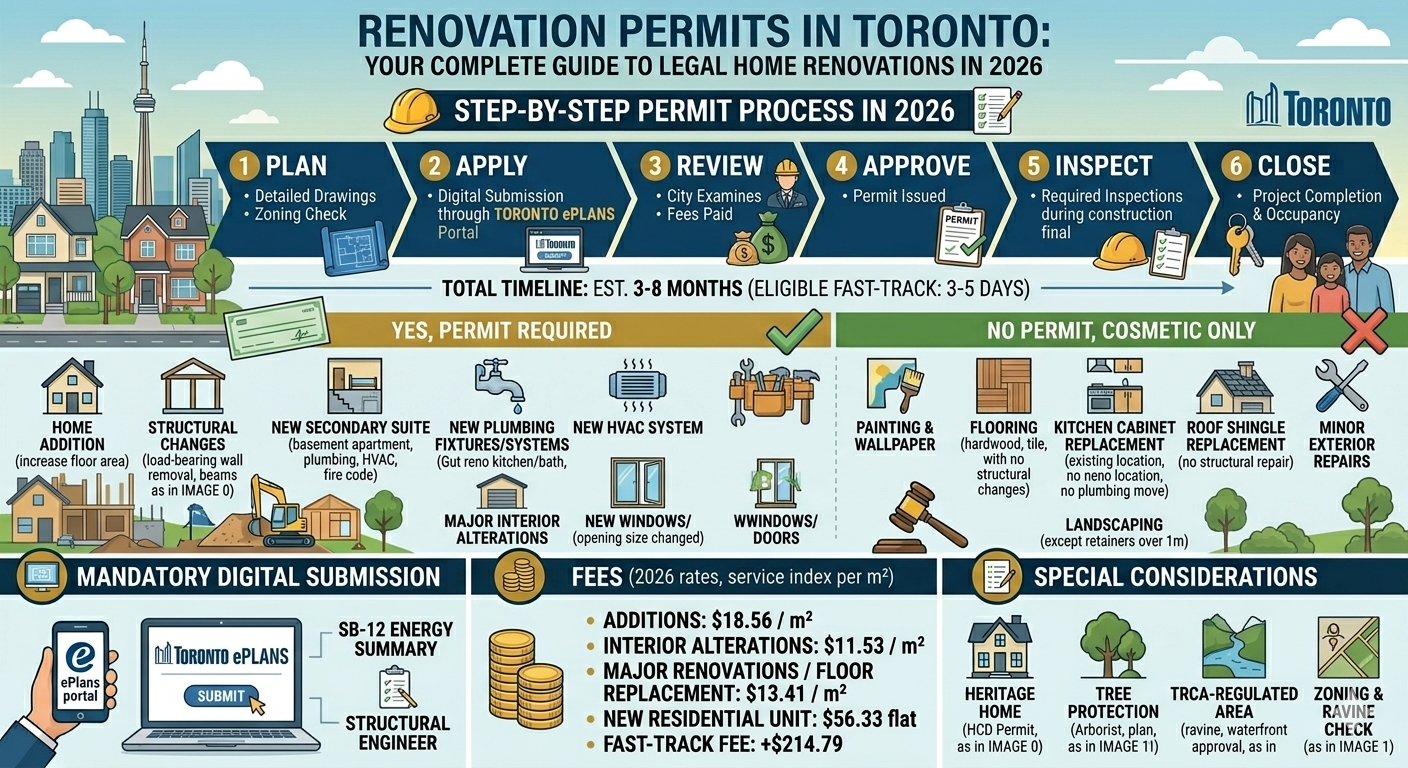
Direct answer. A Toronto renovation permit is required for: structural changes, plumbing relocation, electrical service changes, exterior openings, decks over 24″, and any new dwelling unit (e.g., legal basement apartment). City of Toronto plan-review service standard is 10 business days. Permit fees range from $300 (cosmetic basement finish) to $5,000+ (custom home build).
Key Takeaways
- Permit required: structural, plumbing relocation, new fixtures, electrical service changes, exterior openings, new dwelling units, decks over 24″.
- No permit needed: cosmetic refresh (paint, like-for-like fixture swap, flooring, hardware).
- City of Toronto Application Submission Tool (AST) online portal — service standard 10 business days for residential.
- ESA notification required separately for any electrical scope — filed by Licensed Electrical Contractor.
- TSSA permit required for gas work (water heater, range, dryer, fireplace).
Why Country Renovations. Building Toronto and GTA renovations since 2014. HCRA-registered, licensed plumbing & electrical trades, WSIB-cleared, $5M general liability insured. Free written fixed-price quote in 5 business days. Book a free site visit →
Renovation Permits in Toronto: Your Complete Guide to Legal Home Renovations in 2026
Renovation permits in Toronto are required for most home improvement projects that involve structural, electrical, plumbing, or mechanical work. Whether you’re renovating in Toronto, Scarborough, Markham, Richmond Hill, Vaughan, Mississauga, Brampton, Oakville, North York, or Etobicoke, permit requirements follow similar principles based on the Ontario Building Code, though each municipality has specific procedures and fees.
Why Renovation Permits Matter for Toronto Homeowners
Renovation permits aren’t bureaucratic red tape—they’re legal requirements that protect your family, neighbors, and property value. The City of Toronto issues permits to ensure renovations meet safety standards, structural requirements, and zoning bylaws outlined in the Ontario Building Code. Working without required permits can result in stop-work orders, fines ranging from $500 to $100,000, forced removal of completed work, and complications when selling your home. Insurance companies may also deny claims for damage related to unpermitted work.
Which Renovations Require Permits in Toronto
Major Structural Work (Always Requires Permits)
Any renovation affecting your home’s structural integrity requires a building permit: 1. Foundation work: Underpinning, basement lowering, foundation repairs 2. Load-bearing wall removal: Any wall supporting floors or roof above 3. Additions: Room additions, garage conversions, second-story additions 4. Roof modifications: Structural changes, dormers, skylights over certain sizes 5. Floor system changes: Removing or modifying floor joists, beams
Electrical Work Requiring Permits
Ontario’s Electrical Safety Authority (ESA) requires permits for most electrical work beyond basic repairs: 1. Panel upgrades: Service upgrades from 100A to 200A (cost: $2,500-$4,500 in 2026) 2. New circuits: Adding outlets, lighting circuits, or dedicated appliance circuits 3. Hot tubs and pools: All electrical connections for water features 4. Major appliance installations: Electric vehicle chargers, central air conditioning ESA permit fees in 2026 range from $85 for basic work to $285 for service upgrades.
Plumbing Permits
The Technical Standards and Safety Authority (TSSA) oversees plumbing permits: 1. Bathroom renovations: Moving fixtures, adding bathrooms, rough-in work 2. Kitchen renovations: Relocating sinks, adding gas lines for appliances 3. Water service changes: Main line repairs, backflow prevention devices 4. Heating system work: Furnace installations, ductwork modifications TSSA plumbing permits typically cost $75-$200 in 2026, depending on scope.
Work That Generally Doesn’t Require Permits
1. Cosmetic updates: Painting, flooring, trim work, cabinet refacing 2. Minor electrical: Replacing switches, outlets, fixtures on existing circuits 3. Basic plumbing: Faucet replacement, toilet replacement (same location) 4. Windows and doors: Direct replacements of same size (no structural changes) 5. Roofing: Shingle replacement without structural modifications
Step-by-Step Guide to Obtaining Toronto Renovation Permits
Step 1: Determine Required Permits
Before starting any renovation project, identify which permits you need. The City of Toronto’s online permit tool provides guidance, but consulting with your general contractor or the permit office directly ensures accuracy. For complex renovations involving multiple trades, you may need: – Building permit (City of Toronto) – Electrical permit (ESA) – Plumbing permit (TSSA) – Gas permit (TSSA) – Heritage permit (if applicable)
Step 2: Prepare Required Documentation
Toronto building permit applications require specific documents: Architectural drawings: Site plans, floor plans, elevations, and sections drawn to scale. Professional drawings cost $1,500-$5,000 in 2026 depending on project complexity. Structural drawings: Required for load-bearing modifications, prepared by licensed structural engineers. Engineering fees range from $2,000-$8,000 in 2026. Site survey: Current survey showing property boundaries, existing structures, and proposed changes. Updated surveys cost $1,200-$2,500 in 2026. Project specifications: Detailed descriptions of materials, methods, and code compliance measures.
Step 3: Submit Application and Pay Fees
Toronto building permit fees in 2026 are calculated based on construction value: 1. Projects under $10,000: $334 base fee 2. Projects $10,000-$50,000: $334 + $8.50 per $1,000 of construction value 3. Projects over $50,000: Complex calculation including plan review fees Average permit costs by project type in 2026: 4. Kitchen renovation: $800-$1,500 5. Bathroom addition: $1,200-$2,200 6. Basement finish: $600-$1,200 7. Second-story addition: $3,000-$8,000
Step 4: Plan Review Process
After submission, City of Toronto reviewers examine plans for: 1. Ontario Building Code compliance: Structural, fire safety, accessibility requirements 2. Zoning conformity: Setbacks, height restrictions, lot coverage 3. Heritage considerations: Special requirements for designated properties Plan review typically takes 4-8 weeks for standard projects, longer for complex renovations.
Step 5: Permit Issuance and Inspections
Once approved, you’ll receive your permit and inspection schedule. Toronto requires inspections at key milestones: 1. Pre-pour inspection: Before concrete is poured 2. Framing inspection: After framing is complete, before insulation 3. Insulation inspection: Before drywall installation 4. Final inspection: Before occupancy Inspection fees are included in permit costs, but failed inspections requiring re-inspection cost $150-$300 in 2026.
Permit Requirements by Municipality in the GTA
Toronto Permit Process
The City of Toronto operates the most comprehensive permit system in the GTA. Online applications are available for simple projects, while complex renovations require in-person submission at North York Civic Centre or Toronto City Hall.
Mississauga Permits
Mississauga’s building permit fees are generally 10-15% lower than Toronto’s. The city offers expedited review for an additional 50% fee, reducing review time from 6 weeks to 3 weeks.
Markham and Richmond Hill
Both municipalities follow York Region protocols with additional local requirements. Heritage properties are common in these areas, potentially requiring Heritage Permit applications adding 4-6 weeks to the approval process.
Vaughan Building Permits
Vaughan has streamlined online applications for projects under $25,000. The city’s building department is known for thorough but efficient reviews, with most permits approved within 4-6 weeks.
Brampton and Oakville
These municipalities emphasize pre-consultation meetings for major renovations. While optional, these meetings can identify potential issues early, preventing costly delays later.
Scarborough, North York, and Etobicoke
As part of Toronto, these areas follow City of Toronto procedures but may have local heritage or environmental considerations affecting specific neighborhoods.
Common Permit Challenges and How to Avoid Them
Incomplete Applications
The leading cause of permit delays is incomplete documentation. Work with experienced contractors who understand local requirements and can prepare comprehensive applications.
Zoning Violations
Many renovation delays result from zoning non-compliance discovered during review. Early consultation with planning staff can identify potential issues before substantial design work begins.
Heritage Property Restrictions
Properties in Heritage Conservation Districts or individually designated heritage properties face additional requirements. Heritage permit applications can add 2-4 months to project timelines.
Structural Engineering Requirements
The City of Toronto requires structural drawings for most modifications affecting load-bearing elements. Engaging structural engineers early prevents delays and ensures designs meet Ontario Building Code requirements.
Working with Contractors and Permits
Choosing Permit-Savvy Contractors
Experienced general contractors familiar with local permit processes can streamline applications and prevent costly mistakes. Look for contractors who: – Have active permits on file with local municipalities – Provide permit cost estimates upfront – Include permit timeline in project schedules – Maintain relationships with local inspectors
Contractor vs. Homeowner Permit Applications
While homeowners can apply for permits directly, contractors typically handle applications more efficiently. Professional contractors understand code requirements, maintain relationships with reviewers, and can address issues quickly. General contractors in the GTA charge 3-8% of project cost for permit management services in 2026, but this often saves time and prevents costly errors.
Cost Planning for Permits in 2026
Budgeting for Permit Costs
Include these permit-related expenses in your renovation budget: Direct permit fees: Building, electrical, plumbing permits as outlined above Professional services: Architectural drawings ($1,500-$5,000), structural engineering ($2,000-$8,000), surveying ($1,200-$2,500) Contingency costs: Potential design revisions, re-inspection fees, expedited processing Timeline costs: Carrying costs during extended approval periods
Hidden Permit Costs
Many homeowners underestimate indirect permit costs: 1. Delayed construction starts: Permits taking longer than expected 2. Design revisions: Changes required during plan review 3. Utility connections: Additional permits for new service connections 4. Environmental assessments: Required for certain heritage properties
Timeline Planning for Toronto Renovations
Typical Permit Timelines in 2026
Simple renovations (bathroom, kitchen): 4-6 weeks from application to permit issuance Complex projects (additions, structural changes): 8-12 weeks for plan review and approval Heritage properties: Add 4-8 weeks for heritage review processes Appeals or revisions: Additional 6-12 weeks if initial applications are rejected
Seasonal Considerations
Permit applications peak in spring, leading to longer review times from April through June. Fall applications often process faster, with reviews completed in 75% of typical timeframes. Construction season affects inspection scheduling. Summer inspections are typically scheduled within 48-72 hours, while winter inspections may require 5-7 day lead times.
Enforcement and Consequences of Permit Violations
City of Toronto Enforcement
Toronto’s Municipal Licensing and Standards department actively enforces permit requirements through: 1. Complaint investigations: Neighbor complaints trigger inspection visits 2. Routine patrols: Officers identify unpermitted work during neighborhood visits 3. Utility connection reviews: New electrical or plumbing connections flag potential permit violations
Penalties for Unpermitted Work
Violation penalties in Toronto include: 1. Stop work orders: Immediate cessation of all work until permits are obtained 2. Monetary penalties: $500-$100,000 depending on violation severity 3. Forced remediation: Removal of unpermitted work at owner’s expense 4. Legal action: Court proceedings for persistent violations
Addressing Existing Violations
If you discover unpermitted work in your home, address violations promptly: 1. Hire qualified professionals to assess work against current codes 2. Apply for after-the-fact permits where possible 3. Remediate non-compliant work to meet current standards 4. Document compliance for future sale or insurance purposes After-the-fact permits typically cost double standard permit fees and may require extensive remediation work.
Special Considerations for Different Property Types
Heritage Properties
Toronto’s Heritage Register includes over 9,000 properties with special requirements: 1. Heritage Permit Applications: Required for exterior changes, major interior modifications 2. Conservation requirements: Materials and methods must preserve heritage character 3. Extended timelines: Heritage review adds 2-4 months to standard permit processes 4. Professional consultants: Heritage architects or consultants may be required
Condominium Renovations
Condo renovations face additional requirements: 1. Corporation approval: Board approval required before permit applications 2. Structural limitations: Most load-bearing modifications prohibited 3. Neighbor considerations: Noise restrictions, construction hour limitations 4. Insurance requirements: Additional coverage during construction
Multi-Unit Properties
Renovating duplexes, triplexes, or other multi-unit properties involves: 1. Fire separation requirements: Enhanced fire-rating between units 2. Accessibility standards: Ontario Building Code accessibility requirements 3. Parking requirements: Zoning compliance for unit additions 4. Rental property considerations: Tenant relocation during major work
Frequently Asked Questions About Toronto Renovation Permits
How long do renovation permits take to get approved in Toronto?
Standard building permits in Toronto take 4-8 weeks for approval in 2026. Simple projects like basement finishing typically process in 4-6 weeks, while complex renovations involving structural changes require 8-12 weeks. Heritage properties add 4-8 weeks to these timelines. Expedited processing is available for additional fees, reducing review time by approximately 50%.
Can I start renovation work while waiting for permit approval?
No, construction cannot begin until permits are issued. Starting work before permit approval can result in stop-work orders, fines, and forced removal of completed work. You can order materials and schedule contractors, but no construction, demolition, or installation work is permitted. Violation penalties range from $500 to $100,000 in Toronto.
What happens if I renovate without permits in Toronto?
Working without required permits can result in serious consequences: stop-work orders halting all construction, monetary fines from $500-$100,000, forced removal of completed work at your expense, complications selling your home, and potential insurance claim denials. The City of Toronto actively enforces permit requirements through complaint investigations and routine inspections.
Do I need permits for kitchen and bathroom renovations?
Permit requirements depend on the scope of work. Cosmetic updates like new cabinets, countertops, and fixtures in existing locations typically don’t require building permits. However, moving plumbing fixtures, electrical work, or structural changes require permits. Kitchen renovations involving gas lines, new circuits, or load-bearing wall modifications need multiple permits from different authorities.
How much do renovation permits cost in Toronto for 2026?
Toronto permit costs vary by project value. Basic fees start at $334 for projects under $10,000, with additional charges of $8.50 per $1,000 of construction value. Typical costs include: kitchen renovation ($800-$1,500), bathroom addition ($1,200-$2,200), basement finishing ($600-$1,200), and second-story additions ($3,000-$8,000). Add electrical ($85-$285) and plumbing ($75-$200) permit fees for applicable work.
Can my contractor handle permit applications for me?
Yes, most general contractors can apply for permits on your behalf and typically do so more efficiently than homeowners. Experienced contractors understand local requirements, maintain relationships with permit offices, and can address issues quickly. Contractors typically charge 3-8% of project cost for permit management services in 2026, but this often prevents costly delays and errors.
Conclusion: Ensuring Your Toronto Renovation Success
Obtaining proper renovation permits protects your investment, ensures family safety, and prevents costly legal complications. While the permit process requires time and money upfront, it’s significantly less expensive than dealing with violations, forced remediation, or complications during home sales. Working with experienced contractors who understand Toronto’s permit requirements streamlines the process and helps avoid common pitfalls. From initial planning through final inspections, proper permit management ensures your renovation project meets all legal requirements while protecting your property value. Whether you’re planning a simple kitchen update or a major home addition in Toronto, Scarborough, Markham, Richmond Hill, Vaughan, Mississauga, Brampton, Oakville, North York, or Etobicoke, understanding permit requirements is essential for project success. Ready to start your renovation project with confidence? Our experienced team at Country Renovations Inc. handles all aspects of permit applications, from initial consultation through final inspections. We’ve successfully completed hundreds of permitted renovations across the GTA since 2014, ensuring every project meets local requirements and exceeds client expectations. Contact Country Renovations for a free estimate and let our permit expertise guide your renovation from planning to completion.[/vc_column_text][/vc_column][/vc_row]
Leave a Reply
You must be logged in to post a comment.