

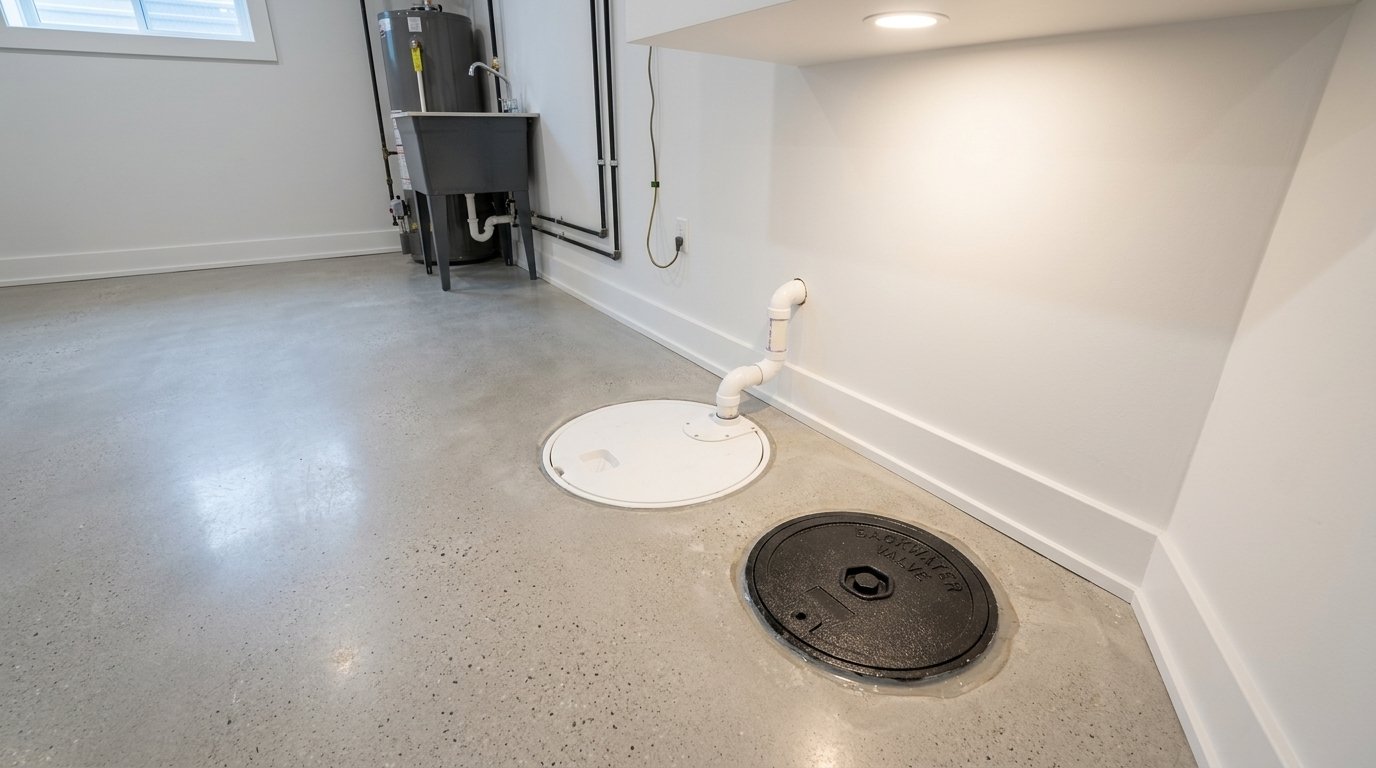
Backwater valve installation Toronto is one of the smartest upgrades a homeowner can make in 2026. If you own a home in Toronto or the GTA, a single severe storm can push the municipal sewer system past capacity — and when that happens, sewage looks for the lowest exit point it can find. Too often, that exit point is your basement floor drain, shower, or toilet. A backwater valve is the single most effective property-level defence against sewer backup, and in 2026 the City of Toronto is paying homeowners more than ever to install one.

This guide covers everything Toronto and GTA homeowners need to know about backwater valve installation Toronto in 2026: real cost ranges, the newly expanded City of Toronto subsidy, permit requirements under the Ontario Building Code, what the installation process actually looks like, and how to fold this work into a larger basement or plumbing project so you only open up your floor once.
Country Renovations has been protecting homes across Toronto, Scarborough, North York, Etobicoke, Markham, Richmond Hill, Vaughan, Mississauga, Brampton, and Oakville since 2014. Here’s what we tell our own clients.
What Is a Backwater Valve and Why Does Your Toronto Home Need One?
A backwater valve (sometimes called a sewer backup valve or backflow valve) is a one-way valve installed on your home’s main sanitary drain — the 4-inch pipe that carries all household wastewater out to the city sewer main. Under normal conditions, the valve’s flapper or gate sits open and wastewater flows freely out of your home. When heavy rain overloads the municipal sewer and pressure reverses direction, the valve closes automatically, physically blocking sewage from surging back into your basement.
Modern valves approved for use in Toronto are fully mechanical. No electricity, no sensors, no manual intervention — the flapper moves with water pressure alone, which means it works during the exact moment you need it most: a major storm that may also knock out your power.
Why Sewer Backup Is a Growing Problem in the GTA
Toronto’s storm intensity has increased noticeably over the past decade, and large sections of the city — particularly older neighbourhoods in Scarborough, North York, Etobicoke, and the downtown core — still rely on combined or aging sewer infrastructure that was never designed for today’s rainfall volumes. When those sewers surcharge, every connected home without a backwater valve is exposed.
The financial stakes are significant. A serious sewer backup in a finished basement routinely generates restoration costs in excess of $40,000 once you account for demolition, disinfection, drying, rebuilding, and replacing contents. Beyond the immediate damage, many insurers in Ontario now limit sewer backup coverage, raise premiums, or apply large deductibles for homes in flood-prone areas that haven’t installed protective devices. Some insurers offer premium discounts once a backwater valve is documented — ask your broker.
Put simply: a one-day installation costing a few thousand dollars (much of it reimbursed by the City) protects against a five-figure disaster and years of insurance headaches.
Backwater Valve Installation Toronto: Cost Breakdown for 2026
Based on current 2026 pricing across the Toronto and GTA market, here’s what homeowners should budget:
| Installation Type | 2026 Cost Range |
|---|---|
| Interior installation (through basement floor) | $1,800 – $3,500 |
| Exterior installation (excavated in yard) | $2,400 – $4,800 |
| Typical all-in average | ~$2,800 |
| City of Toronto permit fee | ~$215 |
| Annual inspection/maintenance (by a plumber) | $100 – $200 |
Most Toronto installations fall between $2,000 and $4,500 all-in, with the average job landing around $2,800. That figure typically includes the valve itself, concrete cutting, excavation to the sewer line (usually 3 to 5 feet below the basement floor), installation in the correct orientation, backfilling, restoring the concrete slab, and coordinating the permit and inspection.
Interior vs. Exterior Installation
Interior installation is the most common approach in Toronto. The plumber saw-cuts the basement slab near where the main drain exits the home, excavates down to the pipe, cuts in the valve, and patches the floor with an access cover left flush at floor level for future inspection. Because excavation volume is smaller and the work happens in a controlled indoor environment, interior installs sit at the lower end of the range — generally $1,800 to $3,500 in 2026.
Exterior installation is used when the interior drain layout makes an indoor valve impractical — for example, when fixtures connect downstream of every viable interior location, or the basement is fully finished and the homeowner wants to avoid disturbing it. Exterior work involves deeper excavation in the yard, which drives the price to $2,400 to $4,800, and can climb higher if the dig runs through interlock, a driveway, or mature landscaping.
What Drives Your Price Up or Down
- Depth of the sewer line. Deeper pipes mean more excavation, more labour, and more restoration.
- Access. A tight mechanical room, a finished basement, or a valve location under stairs adds time. If your basement is unfinished, install the valve before you finish it — the cost difference is substantial.
- Slab thickness and condition. Older homes in Scarborough, East York, and parts of Etobicoke sometimes have thicker or reinforced slabs that take longer to cut and restore.
- Drain condition. If a camera inspection reveals cracked clay pipe or root intrusion at the connection point, you may need a section of drain replaced at the same time. It’s far cheaper to do it while the trench is already open.
- Bundled work. Adding a sump pump, severing a weeping tile connection, or doing drain repairs in the same excavation lowers the per-item cost — and the City subsidizes several of these items too (more below).
Be cautious of quotes dramatically below market. A proper installation requires a permit, correct valve orientation, an accessible cleanout, and a passed City inspection. A valve installed backwards or buried without inspection is worse than no valve at all — it gives you false confidence and voids your subsidy eligibility.
The City of Toronto Subsidy: Bigger Than Ever in 2026
This is the headline change for 2026, and it’s a big one. As of May 1, 2026, the City of Toronto expanded its Basement Flooding Protection Subsidy Program to offer up to $6,650 in total subsidies per property — nearly double the previous $3,400 cap. The expanded amounts apply retroactively to eligible work completed on or after November 12, 2025.
What the Expanded Program Covers
For backwater valves specifically, the City now covers up to 80% of the invoiced cost, to a maximum of $1,600 per device — and up to two devices per property. That means a household can recover as much as $3,200 on backwater valve work alone. On a typical $2,800 interior installation with one valve, the 80% rule caps out at the $1,600 maximum, bringing your net cost down to roughly $1,200.
The broader program also subsidizes:
- A home plumbing assessment — 80% of the cost up to $500, for a licensed plumber to evaluate how your home’s internal plumbing contributes to flood risk. You aren’t required to act on the recommendations to receive this portion.
- Backwater valve alarms — so you know when the valve has closed during a storm.
- A sump pump, alarm, and battery backup power — critical if your weeping tile is being disconnected from the sewer.
- Severance and capping of your home’s storm sewer or external weeping tile connection — which removes a major pathway for stormwater to overload your sanitary line.
Each type of eligible work carries a lifetime maximum per property, and the combined ceiling is $6,650.
Eligibility Rules You Must Follow
The program applies to owners of single-family, duplex, triplex, and fourplex residential homes in Toronto. To qualify:
- The work must be done by a contractor with a valid City of Toronto business licence. DIY installations are not eligible, and hiring an unlicensed contractor means your application will be denied outright. Verify any contractor’s licence through the City’s Business Licence Lookup before work begins — the City itself recommends getting at least two quotes and checking references.
- You must obtain a building permit for the backwater valve and request an inspection once installation is complete. Critically, do not cover or enclose the valve before the City inspection — this is one of the most common ways homeowners accidentally void their subsidy.
- You must consent to City access. A Consent to Enter form allows Toronto Water staff to verify the installation, and the City may photograph or video the valve as part of verification.
- Your invoice must be itemized properly, including the contractor’s name, address, and licence details, with each subsidized component (valve, sump pump, battery backup) broken out separately.
- You can’t have outstanding debts or taxes owing to the City.
Applications are submitted online, and processing can take up to 10 weeks. Note that subsidies are issued first-come, first-served and depend on annual funding approved by City Council — so if you’re planning this work, don’t sit on the paperwork.
What About Markham, Vaughan, Mississauga, and Other GTA Municipalities?
Toronto’s program only applies within City of Toronto boundaries — including North York, Scarborough, Etobicoke, and East York. If you’re in Markham, Richmond Hill, Vaughan, Mississauga, Brampton, or Oakville, check your municipality directly: several GTA cities and regions run their own flood-protection rebate programs with different amounts, eligibility rules, and application windows. When Country Renovations quotes a backwater valve installation anywhere in the GTA, we identify which local program applies and structure the invoice so your application sails through.
Permits, Inspections, and the Ontario Building Code
Do You Need a Permit? Yes — Always.
In Toronto, backwater valve installation in a residential home requires a building permit, applied for through Toronto Building’s Express online portal, which lets you (or your contractor) submit documentation digitally and track the application from submission through approval. The 2026 permit fee for a stand-alone backwater valve is approximately $215. Multi-unit and non-residential buildings require a stand-alone drain permit with additional submission requirements.
Once the valve is installed, a City inspector must verify the work before the excavation is backfilled and the slab is patched. A reputable contractor schedules this inspection as part of the job — if a contractor tells you a permit “isn’t necessary,” walk away. Unpermitted work disqualifies you from the subsidy, can create problems when you sell your home, and leaves you with no municipal record that the device exists.
What the Ontario Building Code Says
Backwater valves are governed by Section 7.4.6.4 of the Ontario Building Code, which sets out where backflow protection is required and how valves must be installed. Key principles that apply to residential work:
- Fixtures located below grade — basement floor drains, basement bathrooms, laundry standpipes — that could be subject to backflow must be protected.
- Mainline valves protecting the whole building must be a normally open design, so the valve doesn’t restrict everyday drainage or trap sewer gases, and closes only under reverse flow.
- The valve must remain accessible for maintenance, which is why every proper installation includes a cleanout cover flush with the finished floor. Burying a valve under tile or laminate with no access is a code violation and makes the device impossible to service.
This is also why installation is genuinely not a DIY project: correct placement matters. A valve installed downstream of the wrong fixtures, or on a shared line it shouldn’t be on, can cause sewage from your own upstairs fixtures to back up into the basement when the valve closes during a storm.
The Installation Process: What to Expect, Step by Step
Here’s how a typical interior installation runs when Country Renovations handles it:
- Camera inspection and assessment. We scope your main drain to confirm pipe condition, locate the ideal valve position, and check for roots or cracks worth fixing while the trench is open. This is also when a home plumbing assessment (80% subsidized up to $500) makes sense.
- Permit application. We file through the Toronto Building Express portal on your behalf and prepare the Consent to Enter form needed for the subsidy.
- Installation day. We saw-cut the slab, excavate 3 to 5 feet down to the main drain, cut in the valve in the correct orientation, and set the access sleeve and cover at floor level. Most residential installations are completed in a single day, typically 4 to 8 hours of on-site work.
- City inspection. The excavation stays open until the inspector signs off on the installation.
- Restoration. We backfill, pour new concrete, and finish the access cover flush with your floor.
- Subsidy paperwork. We provide the itemized invoice, photos, and documentation the City requires, so your application is complete on day one — remember, incomplete applications aren’t processed.
From first call to finished floor, the realistic timeline is one to three weeks, with permit processing and inspection scheduling accounting for most of the wait. The physical work is one day.
The Smart Move: Combine Your Backwater Valve With a Basement Project
Here’s practical advice we give every client: if you’re planning to finish or renovate your basement, install the backwater valve first. Cutting into a bare concrete slab costs a fraction of what it costs to demolish and rebuild finished flooring, and there is no worse outcome than a sewer backup destroying a brand-new basement renovation six months after completion.
The same logic applies to a basement bathroom renovation — any below-grade bathroom is exactly the kind of fixture the Ontario Building Code flags for backflow protection, and roughing in the plumbing while the floor is already open for the valve saves real money on both jobs.
As a full-service general contractor, Country Renovations handles the valve, the plumbing services, the waterproofing, and the finished space under one contract and one warranty — no coordinating three separate trades and hoping their schedules align. It’s one of the advantages of working with a single team for complete Toronto renovation services rather than piecing a project together.
Maintaining Your Backwater Valve
A backwater valve is not install-and-forget. To keep it working — and to keep your insurer and the City happy:
- Inspect it at least once or twice a year and after any major storm. Lift the access cover, check that the flapper moves freely, and clear any debris or grease buildup. Follow the manufacturer’s maintenance directions.
- Consider an alarm. The City subsidizes backwater valve alarms because a closed valve is something you need to know about immediately: while the valve is closed, water from your own fixtures — toilets, sinks, dishwasher, washing machine — has nowhere to go and will back up into your home if you keep using them.
- Budget $100–$200 for a professional annual inspection if you’d rather have a licensed plumber verify operation and document it for insurance purposes.
- Never bury the access cover during future flooring work. If you’re updating your basement floors, tell your contractor where the valve sits so the cover stays accessible.
Frequently Asked Questions
How much does backwater valve installation cost in Toronto in 2026?
Most Toronto and GTA homeowners pay between $2,000 and $4,500 all-in. Interior installations through the basement slab run roughly $1,800–$3,500, while exterior excavated installations run $2,400–$4,800. The typical job averages around $2,800 including the valve, excavation, concrete restoration, permit (~$215), and inspection coordination. After the City of Toronto subsidy, net out-of-pocket cost on an average interior install drops to roughly $1,200–$2,000.
How much is the City of Toronto backwater valve rebate in 2026?
As of May 1, 2026, the City covers up to 80% of the invoiced cost to a maximum of $1,600 per backwater valve, for up to two valves per property — so as much as $3,200 for valve work alone. The expanded Basement Flooding Protection Subsidy Program offers up to $6,650 total per property when you include a sump pump with battery backup, weeping tile disconnection, alarms, and a home plumbing assessment. The expanded amounts apply to eligible work completed on or after November 12, 2025. Work must be permitted, inspected, and performed by a contractor holding a valid City of Toronto business licence.
Do I need a permit to install a backwater valve in Toronto?
Yes. A building permit is mandatory, applied for through Toronto Building’s Express online portal, and a City inspection must be completed before the valve is covered or the floor is patched. Skipping the permit disqualifies you from the subsidy and creates code-compliance problems down the road. The 2026 permit fee is approximately $215, and your contractor should handle the entire process.
Is a backwater valve mandatory in Ontario?
For most existing homes, installation is voluntary — but strongly incentivized. The Ontario Building Code (Section 7.4.6.4) requires backflow protection for below-grade fixtures at risk of backflow, and mainline valves must be a normally open design installed with permanent access for maintenance. Many new builds in flood-prone areas include them as standard, and some insurers effectively require one before offering full sewer backup coverage in high-risk neighbourhoods.
How long does installation take?
The physical installation is almost always completed in a single day — typically 4 to 8 hours for an interior install. Including permit processing and the mandatory City inspection before the slab is patched, plan for one to three weeks start to finish. The subsidy payment itself can take up to 10 weeks after you submit a complete application.
I don’t live in Toronto proper — can I still get a rebate?
The City of Toronto program covers homes within Toronto’s boundaries, which includes North York, Scarborough, Etobicoke, and East York. If you’re in Markham, Richmond Hill, Vaughan, Mississauga, Brampton, or Oakville, your municipality or region may run its own flood-protection subsidy with different terms — we confirm which program applies to your address as part of every quote.
Protect Your Basement Before the Next Storm — Not After
A backwater valve is one of the rare home upgrades where the math is unambiguous: a one-day, permitted installation averaging around $2,800 — with up to $1,600 per valve back from the City of Toronto — versus a sewer backup that routinely costs $40,000+ to remediate and can compromise your insurance coverage for years. With the City’s expanded 2026 subsidy program paying more than ever, and funding issued first-come, first-served, there has never been a better time to get this done.
Country Renovations has been a full-service general contractor serving Toronto, Scarborough, North York, Etobicoke, Markham, Richmond Hill, Vaughan, Mississauga, Brampton, and Oakville since 2014. We handle the camera inspection, the permit, the installation, the City inspection, the concrete restoration, and the subsidy paperwork — and if a finished basement is part of your plans, we build that too.
When you are ready to move forward, professional backwater valve installation Toronto homeowners can trust is only a phone call away. Contact Country Renovations for a free estimate — we’ll assess your home, confirm your subsidy eligibility, and give you a firm, itemized quote with no surprises.