

Commercial-Grade vs Residential Asphalt in Toronto: What Actually Differs (2026)
Two contractors quote your driveway. One says “commercial-grade asphalt” and charges 40% more. The other doesn’t mention it. Are you being upsold, or is the cheap quote cutting corners?
The honest answer is both terms are real and neither is a standard. There is no Ontario specification called “commercial grade.” What the phrase gestures at — heavier mixes, stiffer binder, thicker structure — is genuinely different engineering. But because the label isn’t regulated, it’s also the easiest word in paving to put on a quote without changing anything in the truck.
Here’s what actually differs about commercial-grade asphalt, what it’s worth on a residential driveway, and the five numbers that tell you which one you’re really buying.
First: Ontario doesn’t use “grades” the way the marketing does
Ontario has moved from the older Marshall mix system (the HL designations — HL-3, HL-4, HL-8 — that many contractors still say out of habit) to the Superpave system. Superpave mixes are named for the nominal maximum aggregate size in millimetres:
- SP 12.5 — 12.5 mm stone. The standard surface course, the layer you see and drive on.
- SP 19.0 — 19 mm stone. A coarser binder (base) course that goes underneath. This is roughly what the old HL-4 and HL-8 mixes covered.
- SP 9.5 — finer, used for thin surface lifts.
So when someone says “commercial-grade asphalt,” what they usually mean in practice is one of three things — a coarser structural layer, a stiffer binder, or simply more of it. Those are separable, and you should know which one you’re paying for.
Commercial-grade asphalt: the three things that genuinely differ
1. Structure: one layer or two
This is the biggest real difference, and it’s the one that actually changes how the driveway ages.
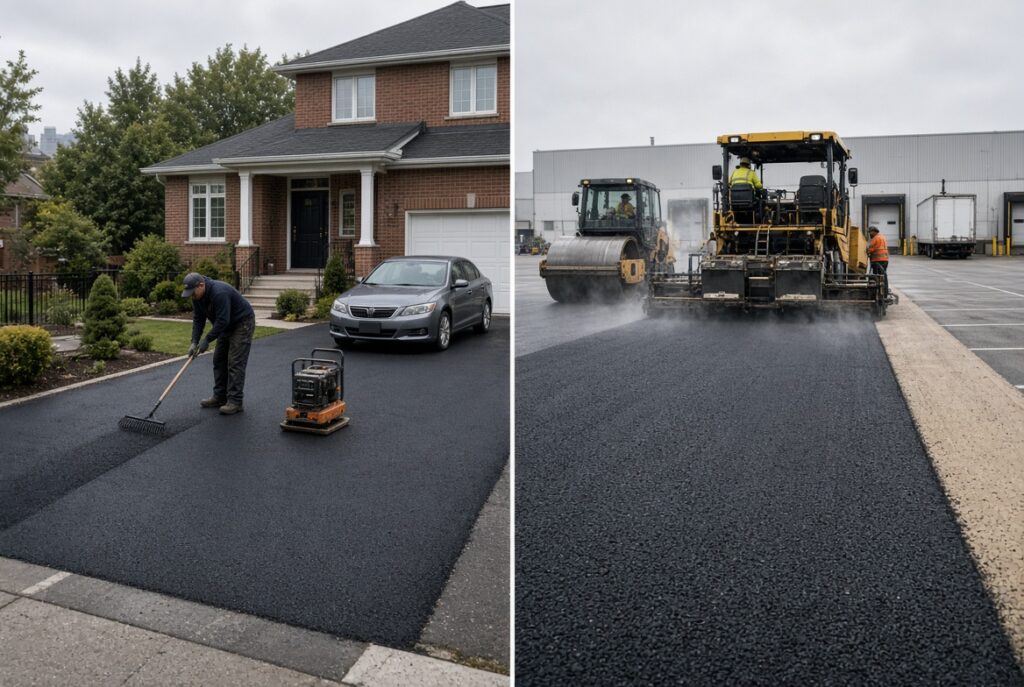
A typical residential driveway is a single surface lift of 2–3 inches over compacted granular base. A commercial-grade asphalt parking lot is built in two lifts: a coarse binder course (commonly 1.5–2 inches of SP 19.0) topped with a finer surface course, for roughly 4–7.5 inches of asphalt in total. Loading-dock and truck-route areas sit at the top of that range.
The two-lift build spreads load far better. That matters enormously under a fully loaded garbage truck. Under a Honda Civic, it is mostly surplus.
2. Binder: the PG grade
Asphalt cement is specified by Performance Grade — two numbers for the hottest and coldest temperatures the binder is designed to survive. In Ontario you’ll encounter:
- PG 58-28 — the standard reference grade, fine for ordinary residential work.
- PG 58-34 — modified for colder winters; better resistance to low-temperature (thermal) cracking.
- PG 64-28 and PG 70-28 — stiffer, polymer-modified, used on high-volume roadways to resist rutting under heavy, slow, repeated loads.
Here’s the part contractors rarely explain: the higher first number is a rutting defence, not a durability upgrade. Rutting comes from heavy vehicles standing or crawling on hot asphalt. A residential driveway doesn’t rut — it cracks. The number that fights cracking in a Toronto winter is the second one. Paying for PG 70-28 on a driveway solves a problem you don’t have; PG 58-34 is more often the genuinely useful upgrade.
3. Aggregate and mix quality
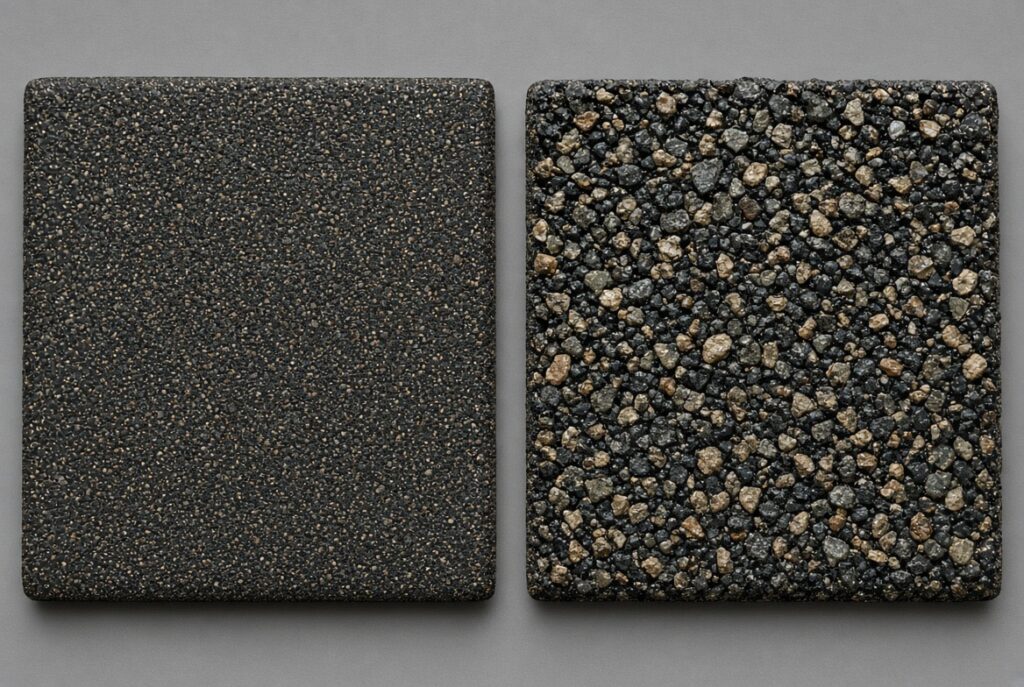
Commercial-grade asphalt mixes generally use a coarser, more angular aggregate skeleton that interlocks under load. Residential surface mixes are finer, which lays down smoother and looks better — the finish most homeowners actually want on a driveway. Finer isn’t weaker for the load a driveway sees; it’s a different optimisation.
Side-by-side
| Typical residential driveway | Commercial-grade asphalt | |
|---|---|---|
| Asphalt thickness | 2–3 in, single lift | 4–7.5 in, two lifts |
| Surface mix | SP 12.5 (legacy HL-3) | SP 12.5 over SP 19.0 binder course |
| Binder grade | PG 58-28 / PG 58-34 | PG 64-28 / PG 70-28 |
| Granular base | 6–8 in Granular A | 8–12+ in, often Granular B sub-base added |
| Designed for | Passenger vehicles | Trucks, dumpsters, constant turning loads |
| Main failure mode | Thermal cracking | Rutting and fatigue |
| Cost premium | — | Roughly 40–80% more |
Does your driveway need commercial-grade asphalt? Usually not.
For a single-family Toronto driveway carrying two passenger vehicles, a properly built residential spec outlasts the owner’s patience. Spending the premium on a stiffer binder while the base underneath stays 4 inches thin is the worst trade in paving: you’ve upgraded the layer that wasn’t going to fail.
Commercial-grade asphalt earns its money when the load is genuinely commercial:
- Multi-unit or rooming-house properties where garbage trucks, moving vans and delivery vehicles turn regularly
- Shared laneways and rear-lane access serving several households
- Driveways used for RVs, trailers, boats, or work trucks — especially anything parked in one spot all summer
- Long driveways with a turning area, since turning loads shear the surface far harder than straight driving
- Anything with a dumpster on it, permanently or during a renovation
If none of those describe your property, put the money into base depth and drainage instead. It buys more years per dollar.
What actually determines how long the driveway lasts
Mix design is maybe the fourth most important variable. Ahead of it, in order:
- Base depth and compaction. Granular A placed in lifts and compacted properly. Invisible on handover day, decisive by year three.
- Drainage. Water has to leave the surface and move away from the foundation. Trapped water plus Toronto freeze-thaw is what heaves and cracks asphalt, regardless of what mix is on top.
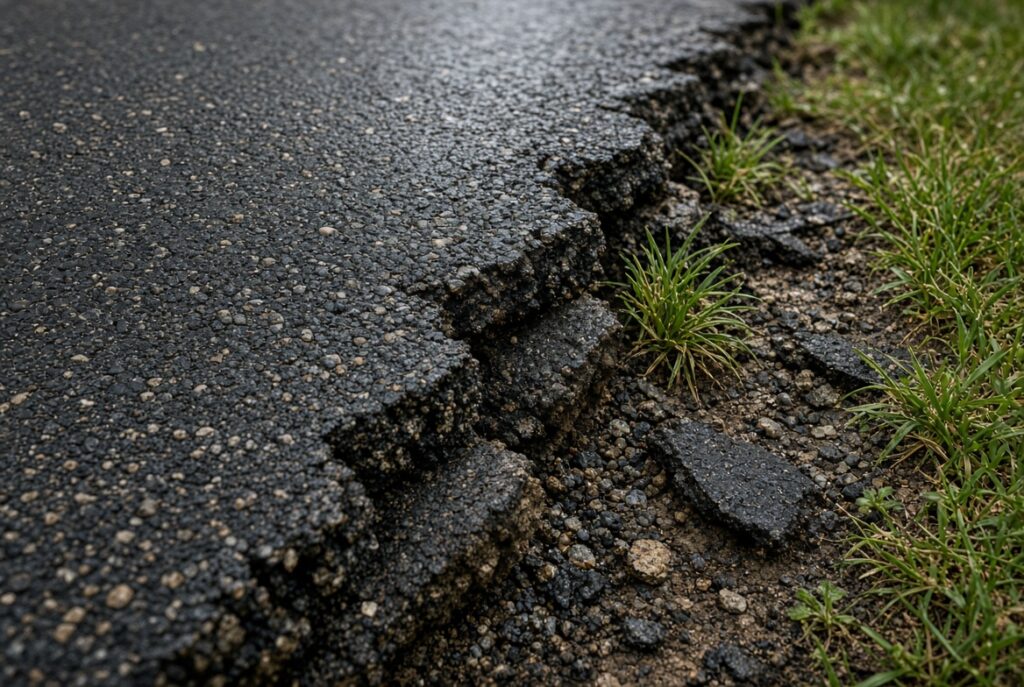
- Edge support. Asphalt fails at the unsupported edge first, where a wheel drops off the side.
- Compaction of the asphalt itself, while it’s still hot enough. A mix rolled too cold never reaches density and will ravel no matter what it cost.
This is the same conclusion as our driveway replacement comparison: the surface gets the attention, the base does the work.
The five numbers to demand in writing
“Commercial-grade asphalt” on a quote means nothing on its own. These five do. Any contractor doing the work properly can answer them without hesitating:
- Mix designation — e.g. SP 12.5 surface, SP 19.0 binder. Not “commercial mix.”
- Binder PG grade — e.g. PG 58-34.
- Compacted thickness per lift, in inches. Note the word compacted — loose asphalt compacts down roughly 20–25%, so “3 inches laid” is not 3 inches finished.
- Granular base depth and type — e.g. 8 inches Granular A, compacted in two lifts.
- Compaction method — what roller, how many passes. A plate tamper on a driveway is a red flag.
A quote that lists these is a quote you can hold someone to. A quote that says “commercial-grade asphalt, 3 inches” is a sentence, not a specification.
Red flags in a Toronto driveway quote
- “Commercial-grade asphalt” with no mix or PG number anywhere in the document
- Thickness quoted without the word compacted
- No mention of what happens to the existing driveway — paving over a failing surface inherits every fault it had
- No base depth stated at all
- Door-to-door offers with leftover material from “a job down the street.” Hot mix cools; leftover material is cold material.
Frequently Asked Questions
Is commercial-grade asphalt worth it for a residential driveway?
For a standard single-family driveway carrying passenger vehicles, usually not. The stiffer binder used in commercial-grade asphalt resists rutting, which is a heavy-truck failure mode that residential driveways don’t experience. The same money spent on deeper compacted base and proper drainage buys considerably more lifespan. It becomes worthwhile if you park an RV, trailer or work truck, or if trucks regularly turn on the surface.
What is commercial-grade asphalt actually made of?
There’s no legal definition, but in practice it means a coarser structural binder course (in Ontario, typically an SP 19.0 mix) placed under the finer SP 12.5 surface course, using a stiffer polymer-modified binder such as PG 64-28 or PG 70-28, with total asphalt thickness around 4 to 7.5 inches instead of the 2 to 3 inches typical on a driveway.
How thick should a Toronto asphalt driveway be?
A residential driveway is typically 2 to 3 inches of compacted asphalt over 6 to 8 inches of compacted Granular A base. Toronto’s clay soils and freeze-thaw cycles make the base depth more important than the asphalt depth — under-building the base is the single most common cause of early failure.
What do HL-3 and HL-8 mean, and are they still used?
They’re designations from Ontario’s older Marshall mix system. HL-3 was a common surface course and HL-8 a coarser binder course. Ontario specifications have moved to the Superpave system, where SP 12.5 covers roughly what HL-3 did and SP 19.0 covers the HL-4 and HL-8 range. Many contractors still use the old names conversationally, which is fine — just ask which Superpave mix they’re actually supplying.
Which PG binder grade is right for Toronto?
For residential driveways, PG 58-28 is the standard reference grade and PG 58-34 is a reasonable upgrade because the lower second number gives better resistance to winter thermal cracking, which is the failure mode that actually affects driveways here. PG 64-28 and PG 70-28 are aimed at rutting under heavy traffic and are generally unnecessary on a residential driveway.
Can you pave commercial-grade asphalt over an existing driveway?
You can physically place it, but we don’t recommend it at any grade. A new lift inherits the cracks, settlement and drainage faults of the surface beneath it, and those reappear within a few years. Paying a commercial-grade premium to overlay a failing base is the least efficient way to spend a driveway budget.
How much more does commercial-grade asphalt cost?
Roughly 40 to 80 percent more than a standard residential build, driven mostly by the extra thickness and the second lift rather than by the binder itself. The exact premium depends on square footage, access for equipment, and how much excavation the deeper structure requires. We quote both specifications side by side so the difference is visible.
Get a quote that states the spec
Country Renovations Inc. paves driveways, laneways and parking areas across Toronto and the GTA. HCRA-registered since 2014, licensed, insured and WSIB-compliant. Whether the job calls for commercial-grade asphalt or a standard residential build, every quote states the mix, the binder grade, the compacted thickness and the base build — so you can compare it against anyone else’s on equal terms.
Request your free estimate or call +1 647-770-5152. We’ll assess the load your surface actually carries and price the specification it actually needs.