

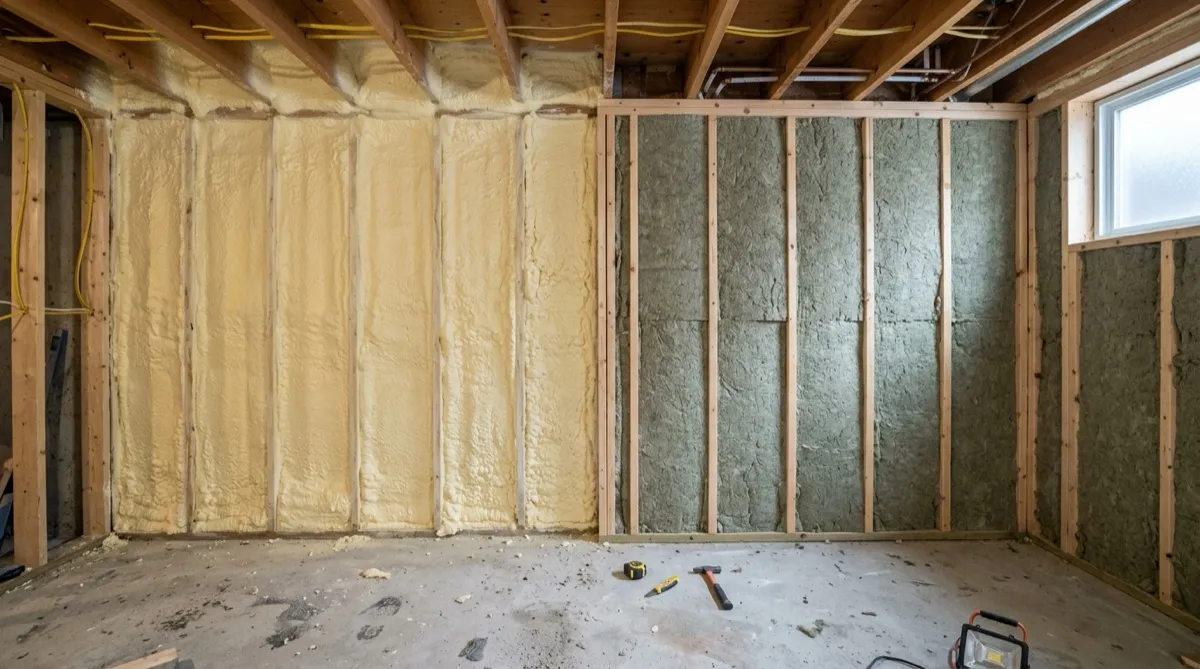
Direct answer. In a Toronto basement, closed-cell spray foam goes against the concrete and on the rim joists; batt insulation belongs inside the stud wall, never touching bare concrete. The best basements use both: foam to stop air and moisture, batts to add cheap R-value behind the drywall.
The spray foam vs batt insulation basement question is not really either/or. It is about which layer does which job. Concrete is cold and damp, and the wrong insulation against it traps moisture behind your finished walls, where you will not see mould until it smells.
This guide covers what the Ontario Building Code requires, how each material behaves on a below-grade wall, where each one belongs and what each approach costs in Toronto in 2026.
What the Ontario Building Code requires
Toronto falls in Zone 1 of the Ontario Building Code's energy standard, SB-12 (under 5,000 heating degree days). For basement walls, the Zone 1 prescriptive packages call for R-20 continuous insulation, or R-12 in the stud cavity plus R-10 continuous.
- "Continuous" matters. It means an unbroken layer that runs past the studs: rigid foam board or spray foam against the concrete. Batts between studs alone cannot meet it, because each wood stud is a thermal bridge.
- Rim joists count too. SB-12 Sentence 3.1.1.1.(14) requires rim joist areas to be insulated to the same level as the surrounding walls.
- Renovations follow Part 11. Finishing an existing basement falls under the code's renovation rules, and your permit drawings name the compliance package that applies. Your designer or contractor should confirm the exact numbers for your house before framing starts.
Sources: OAA Practice Tip PT.36.3, SB-12 prescriptive compliance (2025), SB-12 Zone 1 compliance packages.
Spray foam vs batt insulation: side by side
| What matters in a basement | Closed-cell spray foam | Batt insulation (fibreglass or mineral wool) |
|---|---|---|
| R-value per inch | About R-6 to R-7 | About R-3.5 to R-4.3 |
| Air barrier | Yes, seals cracks and gaps as it cures | No, air moves through it |
| Vapour control | Acts as a vapour retarder at about 2 inches | Needs a separate poly vapour barrier |
| Against bare concrete | Designed for it | Not recommended: traps moisture against cold concrete |
| Rim joists | Best option: one product seals and insulates | Hard to seal; condensation risk behind the batt |
| Continuous insulation (code) | Yes, when sprayed past the studs | No, studs break the layer |
| Installed cost | Higher | Lower |
| Install | Certified crew, rig and curing time | Fast, simple, no special equipment |
| Sound control (interior walls) | Poor | Good, especially mineral wool |
Open-cell spray foam is a cheaper, softer foam at about R-3.6 per inch. It is not a vapour retarder, so we do not use it against basement concrete.
Why Toronto basements need a different approach
Above-grade walls dry to the outside. Basement walls cannot: they sit in damp soil, and concrete holds a lot of moisture. Natural Resources Canada warns that interior insulation makes foundation walls colder, and any humid air that reaches them will condense.
Three things make this worse in Toronto homes:
- Older foundations. Many pre-war houses in the Beaches, Leslieville and the Annex sit on block, brick or rubble foundations that wick water. These need careful detailing and sometimes exterior work first.
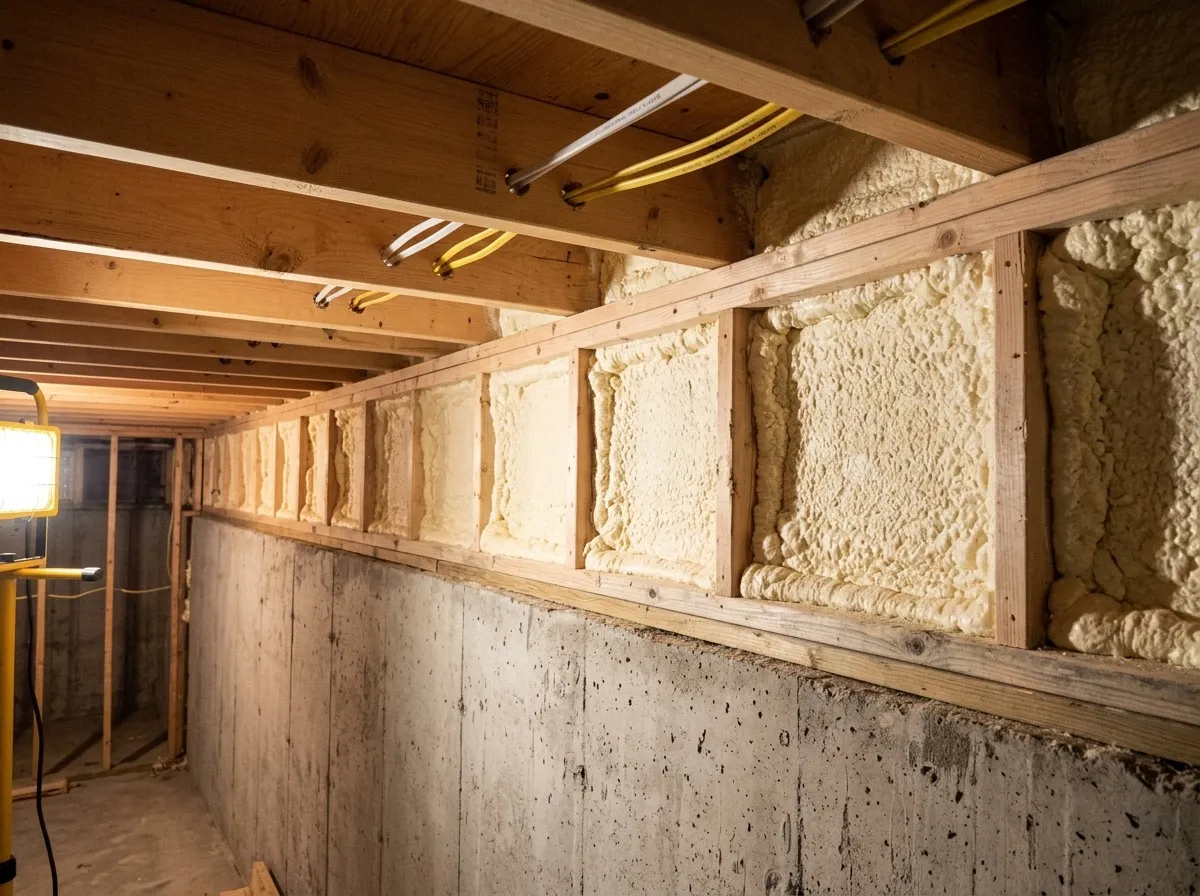
- Rim joists. The wood band where the floor framing meets the foundation is the leakiest spot in most basements. Cold air pours in, and a batt stuffed against it lets warm indoor air reach the cold wood and condense.
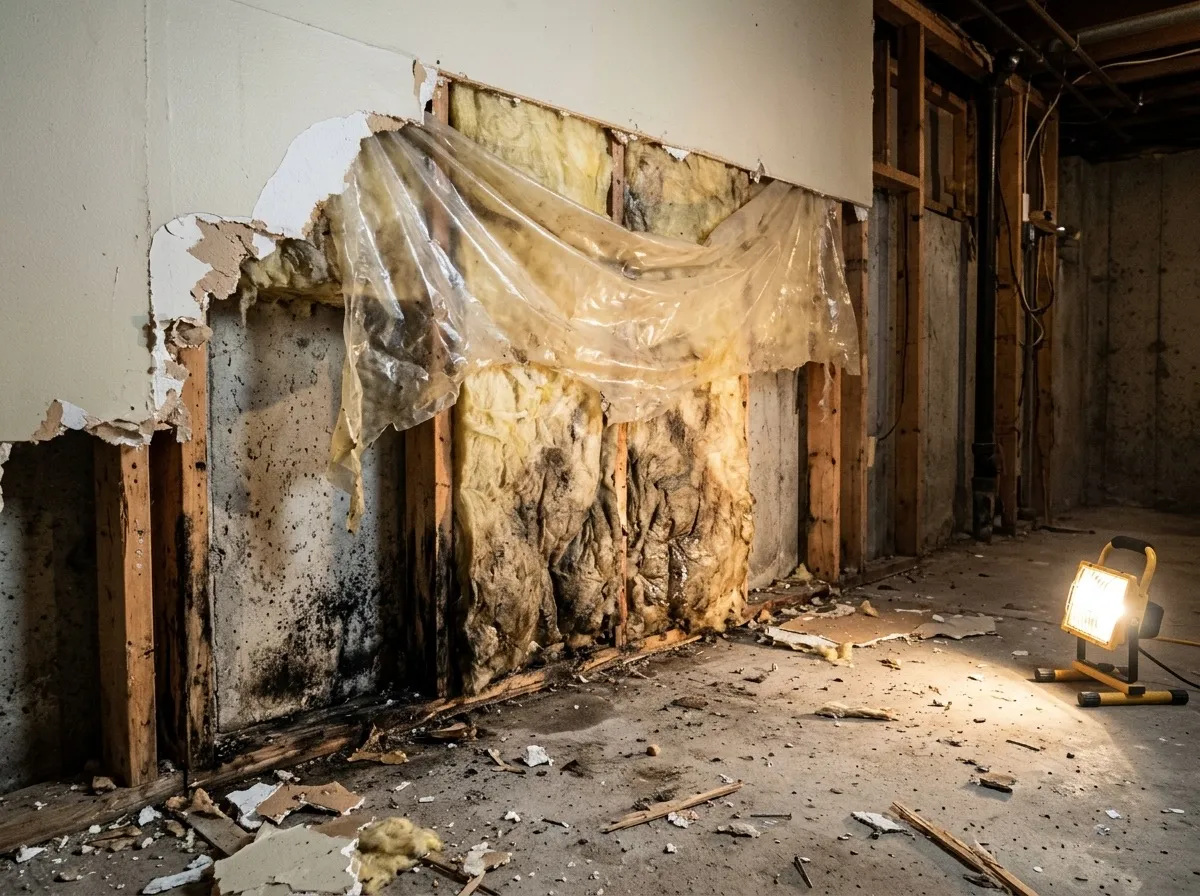
- Old poly-and-batt finishes. Many 1970s to 1990s basements were finished with fibreglass batts and poly directly against concrete. When we open these walls, we often find wet insulation and mould on the bottom plate.
Fix water first. Leaks, grading problems, a failing sump pump or sewer backup risk should be dealt with before any insulation goes in. Our legal basement apartment guide covers the waterproofing side.
Source: NRCan, Keeping the Heat In, Section 6: basement insulation.
Which insulation goes where
| Basement area | What we recommend | Why |
|---|---|---|
| Rim joists | Closed-cell spray foam, about 3 inches | Seals air leaks and insulates in one step, including around the wires, pipes and vents that pass through. Code wants the same level as the walls |
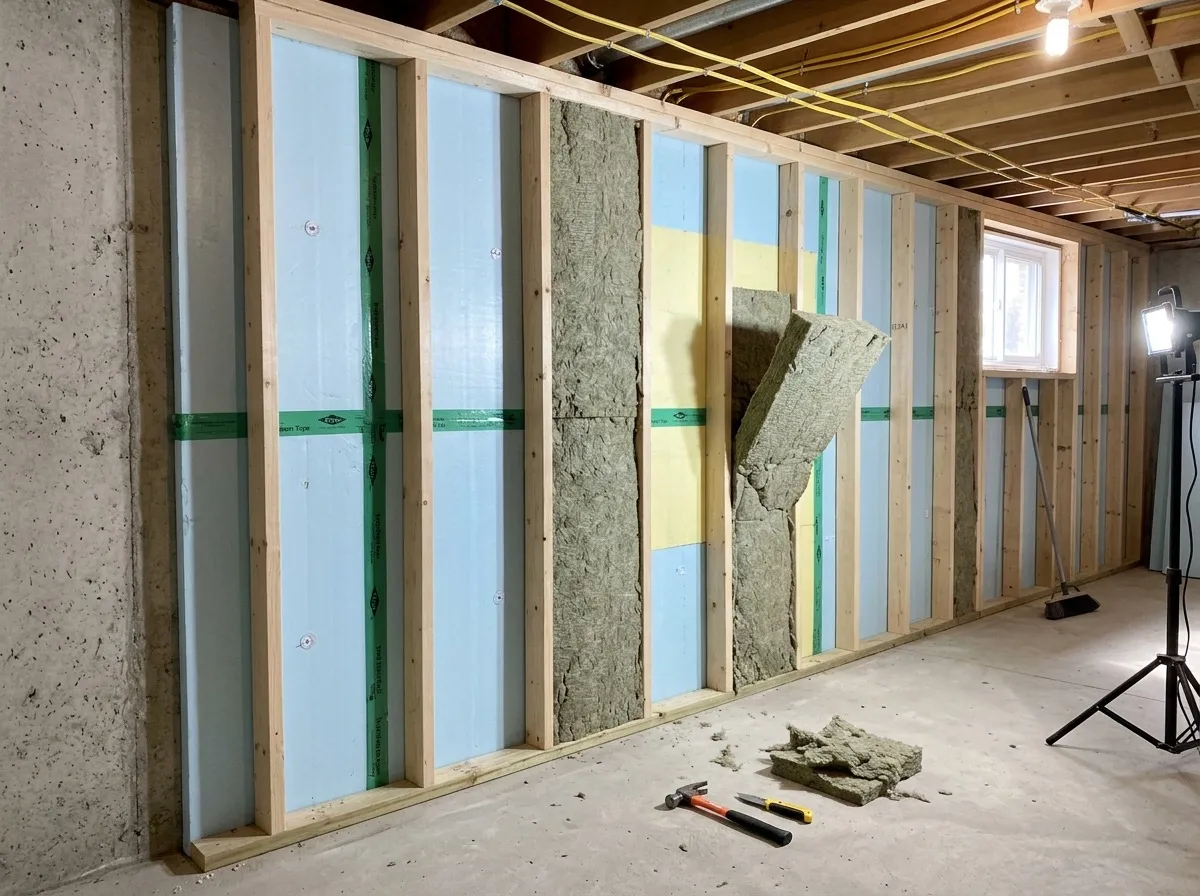
| Foundation walls (code minimum) | 2 inches of rigid foam board against the concrete, then a 2x4 wall with R-14 mineral wool | Meets R-12 + R-10 continuous; foam keeps the concrete side dry |
| Foundation walls (premium) | 2 inches of closed-cell spray foam, then R-14 mineral wool in the stud wall | Foam seals every crack; total about R-26 |
| Foundation walls (thin wall) | Full-depth closed-cell spray foam in the stud cavity | Most R-value in the least depth, useful where every inch of floor counts |
| Interior partition walls | Mineral wool batts | Sound control between bedrooms, bathroom and media room; no thermal need |
| Ceiling between basement and main floor | Mineral wool batts (acoustic) | Cuts footstep and voice noise, commonly specified for legal second units |
| Basement floor (slab) | Rigid foam under a subfloor, only where headroom allows | Warmer floor; usually optional in a renovation |
The one thing we never do: fibreglass batts and poly directly against bare concrete. It is the cheapest finish and the most common reason we tear out old basements.
What basement insulation costs in Toronto
For a typical 900 sq ft Toronto basement, with about 1,000 sq ft of foundation wall and 120 linear feet of rim joist, insulation alone runs $6,300 to $13,800+ installed, depending on the system. Framing, drywall and finishing are extra.
| Tier | System | Installed total |
|---|---|---|
| Good | Spray-foamed rim joists + 2 in. rigid foam + R-14 mineral wool | $6,300 – $8,800 |
| Better | Spray-foamed rim joists + 2 in. closed-cell spray foam + R-14 mineral wool | $8,100 – $11,300 |
| Best | Spray-foamed rim joists + full-depth closed-cell spray foam + acoustic ceiling batts | $10,600 – $13,800+ |
What moves the price: wall height, how many windows and obstructions there are (panels, ducts, plumbing), whether old finishes must be torn out, and any water problems found once walls are open.
Spray foam costs more upfront. It pays back in a drier, tighter basement, fewer drafts upstairs and lower heating bills, and it is the only option that seals the rim joists properly.
Rebates for basement insulation in Ontario
Ontario's Home Renovation Savings Program (run by Enbridge Gas and Save on Energy) lists insulation of attics, walls, foundations and exposed floors at up to $7,700. Foundation insulation falls under the assessment route:
- Book a pre-retrofit home energy assessment before any insulation goes in. Work done before the first assessment does not qualify.
- Do the upgrade, then a post-retrofit assessment confirms it.
- Lower-income households may qualify for free insulation through the Home Winterproofing Program.
Amounts, eligibility and deadlines change, so check homerenovationsavings.ca before you start. If you are planning a basement renovation, we can schedule the work around your assessments so the rebate is not lost.
Frequently asked questions
Is spray foam better than batt insulation for a basement?
Against the concrete and on the rim joists, yes: closed-cell spray foam blocks air and moisture, and batts do not. Inside the stud wall and in interior walls, batts are fine and cost less. Most good basements use both.
Can I put batt insulation directly against a basement wall?
We do not recommend it. Warm indoor air reaches the cold concrete through the batt and condenses, which leads to wet insulation and mould behind the drywall. Put rigid foam or closed-cell spray foam against the concrete first.
What R-value do I need for basement walls in Toronto?
Under the Ontario Building Code's SB-12 Zone 1 packages, basement walls typically need R-20 continuous insulation, or R-12 in the stud cavity plus R-10 continuous. Your permit drawings confirm the exact requirement.
Do I need a vapour barrier with spray foam?
About 2 inches of closed-cell spray foam acts as its own vapour retarder, so a separate poly layer is usually not needed over it. Batt-only and rigid-foam assemblies need the vapour control your designer specifies.
Is spray foam safe in a finished basement?
Yes, once it has been installed by a certified crew and fully cured. The house should be vacated during spraying and for the curing period the manufacturer specifies, usually about 24 hours.
Insulate once, and do it right
The spray foam vs batt insulation basement decision comes down to one rule: foam against the concrete and rim joists, batts inside the wall. Get that right and your basement stays dry, warm and quiet for decades. Get it wrong and the walls come down again.
Planning a basement? See our basement renovation page, read how insulation fits into a full energy-efficient renovation, or contact us for a free consultation.